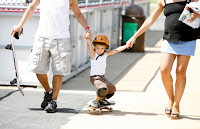
Showing posts with label skateboard. Show all posts

Wednesday, October 10, 2007

Death Skateboards P Melcher Blood Bath 8 Skateboard Deck Review

Death Skateboards P Melcher Blood Bath 8 Skateboard Deck at The RAMP Skateboard Shop
Death Skateboards P Melcher's signature skateboard deck, Blood Bath 8 is a top notch 7 ply deck that features hardcore graphics, light weight, and durability. This deck is slightly wider than most boards but you'll hardly be able to tell once you are on; it's a great choice for any style of skating from street to skate parks, pools, bowls or if you're just a larger size. We were surprised how light weight this skateboard deck is, with a nice concaved, popsicle sticks shape, and plenty of pop. Like we said before the graphics are hardcore but so is Death Skateboards, with a spinning wheel and a crimson trail of blood, it's so very road kill and hence the name "Blood Bath". Once you have a complete assembled with a nice set of matching trucks, fast bearings, and wheels this deck feels and looks very cool. It's reasonably priced. Probably bits on the high side in most walk in establishment, but you can find it fairly reasonable online. Get the P Melcher Blood Bath 8 skateboard deck today if you are into a wider deck with hard core style.

Friday, October 5, 2007

Skateboarding Family

Skateboarding can be a relatively inexpensive sport compared to golf or hockey, with an initial equipment outlay in the neighborhood of $150
Local skateboarder Jake Hibish shows off some of his award-winning moves on the ramp at his home. As the popularity of extreme sports continues to grow, one of our local lads is latching on to the phenomenon with full force. Jake Hilbish, of Forest, recently finished in second place in the Mid-Atlantic Skateboard Series (MASS).

Jake, the son of Brian and Debbie Hilbish, has been skating nearly all of his life. But that's not a surprise when you find out that his father has skateboarded nearly all of his life.

Brian Hilbish, a Brookville alum, was raised in Lynchburg where his skating antics, "got me run off quite a bit," in his words. After a stint in the Air Force, he earned his engineering degree at the University of Colorado. Through it all, Hilbish kept on skating.

Jake's older brother, Nathan, is working on an engineering degree at VCU. Debbie Hilbish said of him, "We tried the organized sports and they just didn't take. Nathan was timid until we put him on a board." She continued,"His confidence and grades all went up."

Jake started skating as a four year old. He played organized ball but felt compelled to make a choice and went with skateboarding.

This year, the family discovered the MASS, which consists of a series of events held in Northern Virginia and Maryland. The eight competitions ran from June until the end of August and are scored on a point system, similar to that used in NASCAR. Jake won three of the individual events outright.

One thing certainly working in his benefit is the existence of a skating ramp on the family's property. The ramp, designed and built by Brian Hilbish is 6 feet high, 24 feet wide and 40 feet long. "I built it because, at the time, that's all Nathan wanted to do," said Brian Hilbish.

It is actually the second ramp to grace the Hilbish estate, the first having been blown down by a tornado in 2001. In the immediate aftermath of that tornado, "Nathan was more worried about the ramp than anything else," Brian Hilbish noted with a chuckle.

Jake could find himself with some headier home-grown competition if some current plans come to fruition. There is a proposal to build a skate park at the Falling Creek Park here in Bedford.

If this park is built, Bedford would join the ranks of other communities that have built such attractions including Blacksburg, Roanoke, Vinton, Christiansburg and Salem.

Father and son skaters Brian (left) and Jake Hibish pose in front of the ramp that Brian built. As Brian Hilbish pointed out, "It's a sport in which some kids who aren't good at other sports kind find a niche. It's also a lifelong sport."

Jake enjoys the sport for a number of reasons. "It's really fun and exciting. You get an adrenaline rush from it," he noted. "You get to determine what things you want to do with a skateboard."

A demonstration by Jake on the skating ramp shows that it is a sport that takes a lot of stamina, strength and coordination. "A friend of mine lost a lot of weight just by skating," declared Jake.

Brian Hilbish added, "I think it's one of the greatest sports for kids if they're brought into the sport right and mentored properly." He also pointed out that skateboarding is a year-round sport that has a lot of camaraderie among the participants.

Skateboarding can be a relatively inexpensive sport compared to golf or hockey, with an initial equipment outlay in the neighborhood of $150.

And, it can be a sport for the more mature set, as well. "I started skating at the park because I was bored with just watching," said the older Hilbish. "For those over forty, if you start out slow and are padded, it's not really dangerous. In fact, a number of fathers have started getting into it."

Original Source: Bedford Bulletin, By Mike Forster

Skater Punks, an essay by Kathy Fish

Skaters Need Skateboards. Don't just sit there, Get involved Today!
Skater Punks You know exactly what I am talking about. We have all seen them: the thrashed skate boards with nightmarish graphics, the bizarre array of boxers peeking out of the ridiculously baggy pants, jewelry protruding from places previously only inhabited by the stray hair trying to avoid being plucked, that's right, the skater punks. They aren't just boys or men; girls who played dress up and Barbie have thrown off the perception of pale pink and purple and are clad in black, brown, army green or any drab variation of the ominous colors Generation X has chosen for their coat of arms. Young men and women dress the same, walk the same, skate the same and sport the same flippantly arrogant attitude. What on earth would possess the youth of our nation to dress, behave and mutilate themselves in such a manner? Have you ever seen an X-Games skate board competition? These people are amazing. Why would you waste that athleticism and agility on a sport that has nothing to offer but a bad reputation, injury and trouble with the law?

"Mom, I'm home! Guess where Grandma took me to today. We found a skateboard at a garage sale and we bought it for $2.00 and we went to the skate park. It is so cool. I met some new friends and they showed me some tricks. Grandma is going to take me back next week," Conner, my then six year old, excitedly gushed as he walked through the front door.

Fear and anger seized me. I didn't know who to yell at first. Conner, seeing the fierce look in my eyes, yelled, "Grandma made me do it!" In her quest to become "cool," grandma had been turned to the "dark side." In Benedict Arnold style, facing battle and guaranteed desecration of her sainthood, she caved, switched allegiances, and sold me out for the price of a smile. I couldn't trust her, or the vipers she was now "hangin" with. Disbelief engulfed me like a dark, damp heavy cloud. My ally was gone, deserted; I stood alone to bear accusations like "you don't understand," "my friends who have cool parents get to skate," "you're closed minded and prejudiced," "just because you're old doesn't mean you know everything." The verbal battle was in full array and the arrows were hitting their target.

I pause from the narration at this time to relate an observation that has come as a morbid dose of reality for me. You will all have the following experience, at one time or another, it is unavoidable. You will supply grandchildren for your parents who have shamelessly begged, bribed, pleaded and blackmailed you to procreate. By giving in to their pleas you will have equipped them with the opportunity to earn their sainthood. Then, watching you stagger from a near fatal battle wound, they will step forward, take the sword from your child's hand and drive the final blow straight through your heart. With this one act they will forever endear themselves to your offspring and irrevocably reveal their true alliances— with them, against you.

'You know honey, you really should come check out the skate park before you make your final decision," a woman I did not know, who bore a striking resemblance to my mother, cooed logically. I spun around, a cornered, wild animal sensing the battle to ensue. "How dare you...We have talked endlessly about the problems with the youth of today, not the least of which is the 'skater-tude'... I entrusted my child to you and this is where you take him?...I don't care if he asked you to, be the adult,...show some back bone. You never had a problem saying the word 'no' when I was his age." My emotional diatribe was unashamedly being ignored. The traitor smiled, winked at Conner and said over her shoulder as she turned to leave: "Conner and I would be happy to let you tag along next time." I was speechless.

Defeated, weary from the staunch defense of ideals and perceptions my faculties began to call an all out retreat. "What could it hurt to go?...are you really afraid of some skater punks?...ratify your assumptions...prove your perceptions...isn't Conner worth your time...are you seriously going to let a 70-year-old grandma be more open-minded than you?" Finally with a sigh of surrender, "I'll go."

As I walked up the dirt trail to the "bowls" I tried to not look as scared as I felt. At first glance all I could see was concrete. There are two large "bowls" that are side by side and have a small lip that connects them. The "track" is the ring around the outer edge of the cement that incorporates two large ramps for building speed for jumps. In the middle there is a crisscross design with stairs and rails for "grinding." The design was ingenious, not much space but lots of options.

Conner threw his board down, put on his helmet, and off he rolled; around the track, up and down the ramps over and over, his smile spreading wider and wider across his innocent face. "Hi Conner," called a tall stereotypical skater. I bristled, started to step forward and the icy stiletto fingers from my childhood grabbed my arm. Without a word my mom rescued Conner from certain social death. "Hi Grandma, who's your friend?" the skater called out. Introductions were made and the grip on my perceptions began to erode.

Then my fears were realized, Conner took a nasty spill trying to grind. His board was too "sticky" to slide on the metal rail and he landed on his elbow and hip. To my surprise the skater punk got there before Conner's over protective mom. He gently picked him up, asked if he was okay, looked to make sure there was no blood, and walked him over to sit down.

"Next time borrow some of my wax to rub on the rail so it slides," came the helpful suggestion from the "punk." I was dumbfounded. Where were the "flippantly arrogant attitudes," disrespectful indifference, and the scorching defiant eyes? "He'll be okay, don't worry," the punk said reassuringly. "Thanks" I mumbled. "Mom, you said you rode a skateboard when you were young, try mine, its fun." "You rode a board? How cool, hop on and see if you remember how to roll" the skater kid smiled. "I wish my parents did something cool like that, then maybe they would understand. You are lucky Conner."

I didn't know whether to be embarrassed or proud. My tattle-tale conscience reminded me of those ten minutes earlier I was reciting the evils of skateboarding to myself. I cautiously placed Conner's board down and assumed the stance. The wheels rolled slowly at first, then faster and my confidence began to build. The adrenaline rush was instant. The faster I went the more intoxicated I felt. What a rush. I could do this all day.

"Mom, could I have my board now?""One more time around," I pleaded as I rolled quickly by."Come on mom, it's my board." I slowed down and jumped off. Conner took off and yelled "Hey mom, watch this."

Teachers come in all shapes, sizes and wear all kinds of different clothes. From eight to eighteen to seventy there are many different people from diverse walks of life that can show us things about who we are, who we think we are and most importantly who we want to become. I didn't change my choice of clothes, music or friends, but my custom board and pierced belly button have raised some eyebrows and given me the opportunity to do a little teaching of my own.

Original Source: realskate.com

Thursday, October 4, 2007

The basics of skateboarding

Learning to ollie? Make sure your board has allot of pop in it!
The basics of skateboarding.

After years of falling and much hard work, we have decided to try and break down the basics so that almost anyone can understand and land tricks. Unfortunately we cannot promise that you’ll be landing any tricks quickly, or every time. We intended this document to only be a guide to assist you while you are learning.

First and foremost you will not land any thing without proper balance. Forget sitting on the carpet or grass; it’s completely different when you begin to roll. If you have ever ridden a bicycle, ice skated, or snowboard you will know this. Proper balanced is ultimately achieved while you are in motion. Learning to roll around comfortably on your deck is the key and will ultimately lead to unlocking accomplished tricks. Through out an entire trick, you should be relaxed, knees slightly bent, balanced and most of all feel comfortable.

Once you feel comfortable and you can roll around with relative ease, it is time to have some fun. Try performing some tricks! All tricks stem from the Ollie. The more proficient you become with performing ollies, the easier tricks will become. The second most important aspect to skating is the pop you get when ollieing. When you are performing a trick, the worst thing you can do is pop with your foot flat. This diminishes the height you will receive and make your trick more difficult to pull off. In other words you do not just stomp down your entire foot, you snap with the ankle downwards to the balls of your foot for lift. Just work on maintaining balance while lifting off and snapping that ankle downwards. Getting a crisp pop will lead increased height and better tricks.

After mastering both balance and ollies, it is now time for a bit more advanced tricks. This primarily applies to learning flip tricks. It works something like this, if you want to do a kick flip, your right foot will be on the far side of the tail, while the heel of your left foot would be entirely off and ready to flick outwards. The same will apply for a heel flip but this time you’re popping foot would be on the other side of the tail. In other words, if you are going to flick off the right side, your popping foot would be primarily on the left side of the decks tail. Putting them on opposite sides creates better leverage making the board flip better.

Lastly, you’ll need to learn how to stop the rotation of the board. This only applies to flip and shuv-it type tricks. Depending on the trick you are performing, different feet will stop the rotation of the board. If your board flips, you are going to catch it with your popping foot in order to stop the flip. If you are doing a shuv-it trick, your front foot or non- popping foot will stop the rotation of the board.

If you are having troubles with any tricks, refer back to these basics and they should help. Practice is the only thing that will make you a better so keep at it and don’t get discouraged.

Wednesday, October 3, 2007

How to Choose Skateboard Trucks - Get yourself a pair and start riding

Get yourself a pair of skateboard trucks and shred today
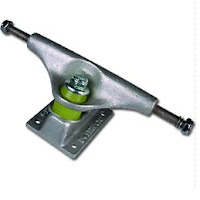
Skateboard trucks are fairly easy to choose. You'll need two to ride. There are numerous brands, colors, graphics, and that choice is really up to your own tatse and style. Generally the axle's width on the truck should be within 1/4" of the deck's width.

The height of the skateboard truck is also a key when selecting what trucks are right for you. The reason you would want to choose a higher skate truck is based upon your style of riding and selection of wheels. Once you start selecting wheels over 56mm, you should consider purchasing high trucks.

High trucks allow for more clearance from the bottom of your board to the surface of the wheel. "Wheelbite" is something you definitely want to avoid. This is when a wheel comes into contact with the board stopping you dead in your tracks, most likely resulting in a painful digger.

Skateboard Decks - How to choose

So many skateboard decks to choose from why just get one?
If you want to skateboard you need one, but the question is, which one is the right for you? Well the good news is that you have many options. Size should definitely be taken into consideration when making your selection.

Before you make your decision, determine what type of riding you do, or plan on doing. This is very important. If you skate streets or do more technical tricks, you're going to want to look for a board in the size range of a 7.5" to 7.87". If you mostly skate pools and parks with heavy transitions, then you may want to consider looking for a board in the size range of 7.87" to 8.25". You also have to take into consideration you own size. If you are 5 feet tall, and weigh 80 pounds, you are not going to want an 8" deck. The deck will be hard to do flip tricks on. This scenario can also be reversed. Don't purchase something too small for you.

Many manufactures have a specific concave for their deck shapes. Concave is basically the mold or the press that shapes skateboard decks. Predetermined steeepness on the nose and tail, along with the body of the deck can be deep, mellow or anywhere in between. This again reflects personal preference and experience.

The graphic also may be an influence in your deck decision. Be sure not to base it all on the art because you may become frustrated or have a hard time skating if you get a board that is not sized right for you.

Medical Center Urges Kids To Stay Safe While Skateboarding

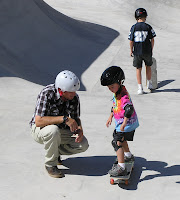
Responsible parents get their kids pads and a helmet
According to the U.S. Consumer Product Safety Commission, approximately 26,000 people are treated in hospital emergency departments annually with skateboard-related injuries. With the growing popularity of the sport and the opening of skateboard parks in the region, Community Medical Center urges kids to stay safe while enjoying these facilities.

Community Medical Center's Emergency Department, which earlier this year introduced a pediatric emergency service to provide care via a dedicated team of physician's board certified in pediatrics or emergency medicine and nurses, is dedicated to the safety of the children of its community. Laurence DesRochers, M.D., FACEP, chairman of emergency medicine at Community, says skateboarding is a great activity for kids, as it promotes good cardiovascular exercise, but he warns it is imperative that kids use proper safety equipment and make sure their skateboards are in good working order to help prevent injury.

"Skateboarding is a good form of exercise, as it helps children develop good balance and body control," he says. "However, young or inexperienced skaters may not have developed the necessary body strength and balance to help protect themselves from falls."

Dr. DesRochers says it is not uncommon for kids to experience sprains, strains, fractures, cuts and abrasions as the result of skateboarding. He adds that skateboarding at a skateboard complex or skate park is safer than skating in the streets or parking lots because skate parks have more even surfaces, no gravel, holes, curbs, moving vehicles or other elements that could cause additional injury during a fall.

"The majority of children who are injured in skateboarding accidents are under the age of 15," says Dr. DesRochers, who oversees an emergency department that includes eight dedicated pediatric beds and a number of special amenities for children. "Injuries, in most part, are due to falls and occur to both first-time and experienced skaters."

He offers the following skateboarding safety tips:

Inspect skateboards prior to use for things such as cracked boards, sharp edges, loose wheels or other defects; Skaters should always wear protective gear including a helmet, knee and elbow pads and slip resistant shoes. Padded clothing such as jackets, shirts and shorts are also available and recommended; Never ride in the street or hitch a ride on a moving vehicle; Don't skate in crowded areas and only one rider per skateboard.

Dr. DesRochers says learning to fall properly can also help lessen the chance or severity of injury. "Practice falling on a soft or grassy surface," he says. "If you are about to fall, crouch down low so you don't have as far to fall and try to land on fleshy parts of the body or try to roll instead of absorbing the fall with arms or hands."

In the event an injury should occur while skateboarding, parents are urged to contact their pediatrician or health care provider immediately, and in urgent situations go directly to an emergency room or call 911.
Original Source: Toms River Times

Skateboarding accident leaves football player comatose

Be smart and stay that way protect your head with a skateboard helmet
A Saguaro High School football player is in a coma this morning after a skateboarding accident. Jake Dunn, a senior, hit his head while longboarding with his friends Sunday. The Sabercat linebacker fell while trying to avoid a car that had pulled out in front of him. Dunn was not wearing a helmet at the time. According to one neurosurgeon, these types of accidents can cause major injuries.

"The most tragic accidents we see are, of course, the low-velocity accidents which are bicycle and skateboard accidents with people who are not wearing helmets," said Dr. Nicholas Theodore.

Dunn's family is hoping for the best, saying their son is the strength in the family. They say it's that strength that has kept them going.
Original Source: azfamily.com

Here comes the judge… Britney or Paris

You are such a girl, shut up and Skate!

Monday, October 1, 2007

Patriotic Duty - Sweet Land of Liberty

Patriotic Duty Buy Now or the Terrorists Win!

Disposable: A History of Skateboard Art

Skateboard Art Disposable
For many skateboard artists the pavement is their only audience. In 2004 renowned skater Sean Cliver attempted to change this with the launch of his book Disposable: The History of Skateboard Art, a 228-page full color text showcasing 1000 of the best skateboard artworks from the last three decades. While local skate stores picked up the text, Cliver found his message wasn't really getting out to the public. This year (thanks largely to a new distributor deal with Ginkgo Press) Cliver has re-launched the book in hopes of granting this art medium exposure.

Do you believe skateboard decoration is a true art form? What's that age old question, is it art? Yeah, sure. Why not?

"There's a lot of other stuff whipped out through the decades and centuries that is equally debatable, but has still wound up in collections, galleries, and museums throughout the world. The only downside is it'll probably all get lumped into the pop-culture waste paper basket, or worse that whole urban guerrilla thing. To tell you the truth, though, I could care less about trying to justify it as an art form. That whole art philosophy thing is for the birds. In fact that is one of the main reasons I did this book: I wanted to portray the art and history as it was and is, not as some random outsider went and theorized."

Friday, September 28, 2007

Your Kid Doesn't Like Sports? They Can Still Stay Fit

Get those kids involved in outdoor activities, skateboarding is great for balance speed stamina and confidence Team sports can help a child gain self-esteem, coordination, and general fitness, and help them learn how to work with other kids and adults. But some kids aren't natural athletes and they may tell you - directly or indirectly - that they just don't like sports. What then?

Why Some Kids Don't Like Teams

Every child doesn't have to join a team, and with enough other activities, kids can be fit without them. But it's a good idea to find out why your child isn't interested. You might be able to help solve any deeper concerns your child might be having, or steer your child toward something else. Talk with your child and let him or her know that you'd like to work on a solution together. That solution might mean making changes and sticking with the team sport or finding a new activity to try.

Here are some reasons why sports might be a turnoff for a child:

Still Developing Basic Skills

Though many sports programs are available for preschoolers, it's not until about age 6 or 7 that most kids have the physical skills, the attention span, and the ability to grasp the rules needed to play organized sports. If your child hasn't had much practice in a specific sport, it may take a while for him or her to be expected to reliably perform necessary skills such as kicking a soccer ball on the run or hitting a baseball thrown from the pitcher's mound. Trying and failing, especially in a game situation, might frustrate your child and make him or her nervous.

What You Can Do. Practice with your child at home. Whether you're shooting baskets, playing catch, or going for a jog together, you're giving your child an opportunity to build his or her skills and fitness in a safe environment. Your child can freely try - and risk failing - new things without the self-consciousness of being around his or her peers. And you're also getting a good dose of quality together time.

Coach or League Is Too Competitive

A kid who's already a reluctant athlete might feel extra-nervous when the coach barks out orders or the league focuses heavily on winning.

What You Can Do. Investigate sports programs before signing your child up for one. Talk with coaches and other parents about the philosophy. Some athletic associations, like the YMCA, have noncompetitive leagues. In some programs, they don't even keep score.

Keep in mind that as kids get older, they can handle more competitive aspects such as keeping score and keeping track of wins and losses for the season. Some kids may be motivated by competitive play, but the average child may not be ready for the increased pressure until he or she is 11 or 12 years old. Remember that even in more competitive leagues, the atmosphere should remain positive and supportive for all the participants.

Stage Fright

If your child isn't a natural athlete, or is a little shy, he or she might be uncomfortable with the pressure of being on a team. More self-conscious kids also might worry about letting their parents, coaches, or teammates down. This is especially true if the child is still working on basic skills and if the league is very competitive.

What You Can Do. Keep your expectations realistic - most kids don't become Olympic medalists or get sports scholarships. Let your child know the goal is to be fit and have fun. If the coach or league doesn't agree, it's probably time to look for something new.

Still Shopping for a Sport

Some kids haven't found the right sport. Maybe your child didn't have the hand-eye coordination for baseball, but he or she has the drive and the build to be a swimmer, a runner, or a cyclist. The idea of an individual sport also can be more appealing to some kids who like to go it alone.

What You Can Do. Be open to your child's interests in other sports or activities. That can be tough if, for instance, you just loved basketball and wanted to continue the legacy. But by exploring other options, you give your child a chance to get invested in something he or she truly enjoys.

Other Barriers

Different kids mature at different rates, so it's common for there to be a wide range of heights, weights, and athletic abilities among kids of the same age group. So if your child is much bigger or smaller than other kids of the same age - or less coordinated or not as strong - he or she may feel self-conscious and uncomfortable competing with them. Your child also may be afraid of getting injured, or worried that he or she can't keep up. A child who is overweight might be reluctant to participate in a sport, for example, while a child who has asthma might feel more comfortable with sports that require short outputs of energy, like baseball, football, gymnastics, downhill skiing, and shorter track and field events.

What You Can Do. Give some honest thought to your child's strengths, abilities, and temperament, and find an activity that might be a good match. Some kids are afraid of the ball, so they don't like softball or volleyball, but may enjoy an activity like running. If your child is overweight, he or she might lack the endurance to run, but might enjoy a sport like swimming. Your child may be too short for the basketball team, but may enjoy gymnastics or wrestling.

Keep in mind that some kids just prefer sports that focus on individual performance rather than teamwork. Remember that the goal is to prevent your child from feeling frustrated, wanting to quit, and being turned off from sports and physical activity altogether.

With good communication, you may be able to address your child's concerns. Other issues may naturally fade as your child grows. If you can understand what your child is going through and provide a supportive environment, you can help your child succeed in whatever activity he or she chooses.

Ways to Stay Fit Outside of Team SportsEven kids who once said they hated sports might learn to like team sports as their skills improve, or if they find the right sport or a league with the right level of intensity. But even if team sports never thrill your child, there's plenty a kid can do to get the recommended 60 minutes or more of physical activity each day.

Free play can be very important for a child who doesn't play a team sport. What's free play? It's the activity kids get when they're left to their own devices, like shooting hoops, riding bikes, playing whiffleball, playing tag, jumping rope, or dancing.

Outside of the most common team sports, your child might want to try individual sports or other organized activities that can boost his or her fitness. Here are some ideas:

skateboarding
cycling
inline skating
martial arts
swimming
horseback riding
dance classes
cheerleading
hiking
golf
tennis
fencing
gymnastics
yoga and other fitness classes
Ultimate Frisbee
running

Supporting Your Kid's Choices

Even if the going's tough, work with your child to find something active that he or she likes. Try to remain open-minded. Maybe your child is interested in an activity that is not offered at his or her school. If your daughter wants to try flag football or ice hockey, for example, help her find a local league or talk to school officials about starting up a new team.

You'll need to be patient if your child has difficulty choosing and sticking to an activity. It often takes several tries before a child finds one that feels like the right fit. But when something clicks, you'll be glad you invested the time and effort. For your child, it's one big step toward developing active habits that can last a lifetime.

Original Source: kidshealth.org

The Faction - The Godfathers of South Bay Punk and Skateboarding

The Faction Godfathers of San Jose Skate Punk Scene
The Faction was a hardcore punk rock band from Halloween 1982 until Halloween 1985. Coming from the heart of the once skateboarding capital of the world, (Thats San Jose, if you though I was talking San Francisco or Santa Cruz you're just wrong!) the band was one of the original "Skate Rock" bands whose music and lifestyle tastes centered on skateboarding and punk rock.

One of skateboarding's brightest stars for 20 plus years (he's been arguably the best all-around skateboarder in the world) played bass, and then guitar, in the Faction. Steve Caballero probably attracted a lot of young skateboarder's interest to the band, but the music kept us coming back for more, and he wasn't the only skater in the band. Singer Gavin O'Brien was a heavy local at the Winchester Skatepark and was more than able to hold his own in any session: vert, street, banks, whatever. Adam "Bomb" Segal's trademark high top Vans in all the bright, cool colors of the day had ollie holes on both shoes-the dude was doing switch tricks before anyone. He was a damn fine guitar player, too. Keith Rendon (drummer #1), Ray Stevens, II (bass) and Craig Bosch (drummer #2) were all accomplished skaters; Craig even has a trick named after him: the Bosch (a invert to blunt on a curb, ledge, etc).

But as much as the Faction were into skateboarding, they were just as much about playing loud and fast and heavy punk rock with an emphasis on guitars. The first lineup was Adam playing guitar, Steve playing bass, Keith on drums, and Gavin singing. I think Corey O'Brien had a pretty steady gig as the roadie, too. As a four piece, they recorded two 7" EPs, one LP, and songs for several comps, including the infamous Thrasher "Skate Rock" tape (vol.1) and LP (vol. 2). In 1984, Keith left the band, Craig came aboard, Stevie switched from bass to guitar, and Ray Stevens (who had played in such great bands as the Drunk Injuns and Los Olvidados, and more recently, the Clay Wheels) lent his bass skills. As a five piece, they recorded two more 12" EPs: "Dark Room" and the posthumous "Epitaph," with six songs each. Thirty-four songs in all, recorded over two and a half years, which progress from fairly simple fast thrash/punk to heavy and layered quality punk songs that are fast and loud and beautiful!

As Adam got more into heavy metal (Went on to form The Living End, which became The End), his influence on the guitar leads became more prevalent, but was just one of the factors that led to the band's breakup. It was a sad day in early November 1985, when they'd finaly broken up.

Faction shows were fun and chaotic, and all of us westside San Jose skaters were always up for them: they were an event not to be missed. We never missed one whenever they played in San Jose or SF. I won't go into how it was different then; if you weren't there, you wouldn't understand.

"Collection..." comes with a list of every Faction gig they ever played, including the three shows represented by four songs on the CD. "Spineless Majority" was one of my favorite songs, and they never recorded it in a studio, so we used it live from a Halloween 1984 show live in the studio at KFJC, the South Bay's dominant force in punk rock radio for at least 15 years, way before "it was safe," as Gavin put it in the liner notes. Ironically, that song is about being a free-thinker in a world of jocks, idiots, rednecks: the Spineless Majority. If you're into the history of hardcore/punk rock, it's all there: shows with Social Distortion, Void, Big Boys, JFA, Executioner, Corrosion of Conformity, the Melvins, Scream, Agent Orange, Aggression, Suicidal Tendencies, RKL, Code of Honor, Wasted Youth... the list goes on. Those bands were in good company.

The CD also has a dupe of the original Love 22 dollar bill which was found in a San Jose mall and started a mini phenomenon, plus lyrics to all 28 songs.

Thursday, September 27, 2007

Longboarding, transportation trend among adults

No waves where you live? Start longboarding today!
"Hey, Dad, can I borrow your skateboard tonight?"

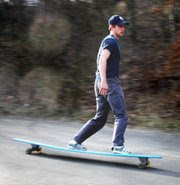
If that's a sentence you have never heard, you probably haven't heard of longboard skateboards. Longboards are the hottest thing in skateboarding for adults. At the basic level, longboards are exactly that: longer skateboards, from 42 to even 80 inches in length, compared with regular boards that are 30 to 38 inches. The biggest difference is these sidewalk surfboards are designed for comfortable riding, not X Games-type tricks on the halfpipe or at the skate park.

"A general rule of thumb is 'the longer the board, the older the rider,' " says Ken Perkins of Arbor Snowboards and Skateboards, whose Hawaii-influenced designs are among the most popular sold.

"It's not unusual to see 40-year-olds commuting on them. During the recent New York transit strike, I saw some Wall Street types riding their boards to work."

Longboards are more stable and smoother riding because the board is more flexible and the wheels are made of softer plastic, allowing them to roll over pebbles and rough concrete that could cause a trick boarder to crash.

"About 85% of skateboarders leave the sport by the time they reach 18," says Michael Brooke, publisher and editor of Concrete Wave, a magazine dedicated to longboarding. "The high attrition rate is due to the true difficulty of doing the tricks. They're very technical and sometimes dangerous."

In 1998, a U.S. Consumer Product Safety Commission study said 80% of the then-11.4 million U.S. skateboarders were under 18. Seven years later, a report by Transworld Skateboarding magazine said skaters 6 to 17 represented only half the nation's 16.4 million skateboarders. Hence the trend toward longboarding. It has become the No. 2-ranked skateboard activity in North America, according to a study by Label Networks, a Venice Beach, Calif., company that tracks youth culture trends. Street-style trick skating is first, and vert-park skating (half-pipe style tricks) is third.

"It is more utilitarian," Kathleen Gasperini, senior vice president of Label Networks, says of longboarding. "You can use it as transportation or have your dog pull you around the neighborhood.

"Girls (whose participation levels in longboarding are 2% higher than boys) love it because it is easier than dropping into a vert ramp and a lot more fun."

Transforming trends

As with regular skateboards, longboards have their gnarly roots in surfing. In the early 1600s, Hawaiian surfriders used 18- to 25-foot mahogany and balsa boards. The modern 8- to 12-foot surfboard emerged in the 1930s. Today's highly maneuverable plastic-foam boards are as small as 6 feet in length. Skateboarding went through a similar but more accelerated metamorphosis. Skateboarding was created in the late 1950s by bored surfers looking for something to do until wave conditions improved. They bolted skate wheels to planks and cruised beach roads and sidewalks, sometimes setting up slalom courses in parking lots. In the 1960s, however, Tony Alva and his merry band of Dogtown surfer-skaters developed a skateboarding style that mimicked the swooping cutback moves of real surfing. Boards got smaller to accommodate their use in empty swimming pools. This evolved into halfpipe ramps and street-skate parks that emphasized riding on rails and ledges.

"That's when they threw the baby out with the bathwater," Brooke says.

Long days journey

Today's longboards are a return to those early days of road riding and slalom racing. Some longboarders are even going to extremes, in a laid-back, longboard sort of way. Adam Colton and two of his friends rode their longboards nearly 3,000 miles from Newport, Ore., to his home in Springfield, Va., last year. They skated more than 50 miles a day and had to tape their sneakers with thick layers of duct tape to keep them from disintegrating.

"The key to the whole trip was switching legs to push off, otherwise I would have had one huge leg," Colton says.

Colton, 22, and associate Adam Stokowski, 21, also from Springfield, are taking longboards in a completely new direction by choreographing dance steps to be performed on them. They are also taping promotional videos for a line of longboards.

"I hurt my leg doing tricks," the lanky Stokowski says. "My parents are really happy that I'm able to make a living with longboards."

Parents aren't a visible component of trick skating, but Gasperini says longboards are giving the sport a cross-generational boost. "In longboarding, you now have parents who used to do vert riding skating with their young kids," she says. "This is the first time that has happened."


Original Source: USAToday

Wednesday, September 26, 2007

Skateboarding as transportation

Old School Bombers Longboards Cruisers
San Francisco, Ca. Everyday, unless it’s raining, Ramsey Garcia, 30, rolls his longboard (a three-foot skateboard with large black wheels) to San Francisco State or to work downtown. He rarely uses his a car and he doesn’t have a bicycle; the skateboard is his principle transportation from his house on Sloat Boulevard. “It takes a good portion out of my daily commute,” said Garcia, a native of San Clemente. “And it gets my heart rate up to keep me warm in a colder city.”


Longboard skateboards, different than those used for ollies, 360 flips and grinds, are becoming a trendy form of transportation. According to the San Francisco Skateboard Task Force, Garcia is one of an estimated 25,000 skateboarders who live in San Francisco. Many ride their boards as a form of alternative transportation although it’s illegal on city streets and many sidewalks. “Skateboard use, as transportation, on the streets and sidewalks of the city is rampant,” according to the Task Force’s 2004 Skateboard Master Plan. “While current law only permits skateboard use on residential sidewalks between dawn and dusk, real usage is going on nearly around the clock.”

For skaters like Garcia the ride can be a haphazard gauntlet of speeding cars, pedestrians, potholes and police. “Scary moments? I’ve had a few,” Garcia wrote in an e-mail, “a couple of close encounters with cars pulling out into traffic and not seeing me on the shoulder.” The law is another risk for skaters. When Garcia rolls to the east edge of the SFSU campus, he always tries to remember if it’s a protest day or not. If a protest is happening, he can’t ride through the sloped campus because University police are on the prowl, said Garcia. A run-in with the police could mean a ticket, a fine and possibly confiscation of his board. Garcia has been warned several times. “If I see them I try to hop off,” Garcia said. “Or I’ll have my headphones on and pretend like I don’t hear them.”


In California, skateboard law varies from county to county, city to city even sidewalk to sidewalk. State law allows “transit boards, public agencies, and local authorities,” to specify where skateboards can be used on public property. San Francisco traffic code states that skateboards cannot be used on any city street at any time, only on residential sidewalks from dawn to dusk. “When compared to other locales both in and out of California, San Francisco has the most restrictive code (as of January, 2004) to be found,” according to the Skateboard Master Plan.


The problem, said Adam Colton who in 2005 pushed his longboard 3,000 miles across the United States for charity, is that police don’t distinguish between street skaters that often damage property with their daring grinds and longboard skaters, which are usually harmlessly cruising. “Unfortunately, the law doesn’t allow for that,” said one San Francisco State University Police Officer. This results in skateboards being used for transportation throughout San Francisco “illegally as often as legally,” according to the Skateboard Task Force. But a few ‘no skateboarding’ signs and obscure traffic codes won’t stop skaters altogether. “Overall, this city has revived my passion for skating,” said Garcia, who has never been hassled by police for skateboarding outside of university grounds.

Original Source: Broowaha, By: DrSinValley

Tuesday, September 25, 2007

Today's society is a little more extreme

Let the rebel inside you out to pick up a skateboard
Today's society is a little more extreme than it used to be. We drive faster, hit harder and take more risks.

Decades ago most kids dreamed of becoming a star football, baseball or soccer player. But kids today are more likely to pick up a skateboard, in addition to playing other more traditional sports. Skateboarding, one of the fastest growing sports behind snowboarding, is now considered normal.

"(Skateboarding) is still a form of rebellion, but it's approachable," said Andy Roberts, an undeclared sophomore.

That wasn't always the case. Skateboarding used to be considered the radical, bad-boy thing to do. It was a true underground sport.

Skateboarding has been in and out of popularity ever since it started. Many saw it as a fad, similar to lava lamps or bell-bottoms. Skateboarding rose in popularity in the early '80s when skaters built their own vertical ramps and formed a big underground movement. This is how skateboarding legends such as Tony Hawk got their starts. Then, as history repeated itself, the skateboarding fad faded out once again.

The hardcore skaters, however, didn't stop and the sport's popularity rose again in the '90s as skateboarding reappeared with a raw, edgy and dangerous attitude. Skateboarding came with the punk movement this time, and the image of the poor, angry skater-punk actually helped fuel its popularity.

Then in 1995, ESPN -- the self-proclaimed worldwide leader in sports -- expanded into the extreme sports vein with an extreme games competition in Rhode Island.

The competition was set up to create an international gathering of action sports athletes. The Extreme Games had 27 events in nine categories, which included bungee jumping, eco-challenge, in-line skating, skateboarding, sky surfing, sport climbing, street luge, biking and water sports.

The competition received an enthusiastic response from athletes, spectators and sponsors. The impressive reaction prompted ESPN to announce that the games would be held annually, instead of bi-annually as originally planned.

With the new year, a new name for the Extreme Games emerged: X Games. The X Games have grown each year since by adding more events, throwing bigger tricks and increasing media coverage.

In 2002, ESPN, ESPN2 and ABC Sports all covered the games. They set the record for the most watched X Games ever with nearly 63 million people tuning in. The first 24-hour X Games coverage was in 2006, when 10 different stations broadcast it.

Media coverage has played a huge part in the popularity of the X Games. The mainstream population depends on television coverage and is a major factor in pulling skateboarding and other extreme sports closer to mainstream.

It also helped that the marketing didn't come off as anti-authoritarian, said Devin Deaton, a junior in marketing.

The commercialization of new media and products continue skateboarding's growth, as well. Extreme sport video games, such as the Tony Hawk Pro Skater series, are popular with kids regardless of whether or not they skate.

Better parks and boards have evolved with the shift into mainstream. Skateboard-specific companies have arisen and now innovate and invent new things to better the sport.

Skateboarding is not the only extreme sport that has benefited from the X Games. Snowboarding, BMX riding and Motocross have seen rapid growth spurts after becoming a part of the X Games.

Snowboarding started in 1965 in Michigan when Sherman Poppen fixed two skis together so his daughter could surf down the hill. He called it the snurf. Jake Burton, Demetrije Milovich and Tom Sims specialized and refined their own board designs in the early '80s and helped get the snowboard industry rolling.

Through the mid-'80s, the snowboard craze grew. In 1997, the snowboard big air contest was a part of the first Winter X Games. Then a year later, snowboarders participated in the Winter Olympics for the first time in Nagano, Japan, with the slalom and half-pipe events.

Snowboarding has progressed and added more events to the X Games, such as the Superpipe, and is the fastest growing sport.

BMX, or bicycle motocross, started in the '70s when kids modified their bicycles to emulate their motorcycle motocross heroes. Imitation led to innovation and BMX became a sport all its own.

BMX was a part of the first X Games. The only event for it was stunt biking. In the years following, more events were added to the BMX event, including vertical riding, big air, flatland stunts, street stunts and racing.

Motocross, or Moto X, began after World War II with flat races. In 1971, Moto X held a race on a temporary course at Daytona. All races prior to it had been held in rural, countryside areas, but this race brought it to the people. A year later, Moto X races were brought to urban stadiums and its popularity increased.

The level of competition also grew. Through the '80s and '90s, teams, sponsors, manufacturers and others worked to bring Moto X to a new audience. They got their chance in 1999, when Moto X became an X Games event.

The X games have become a family event and a type of Olympics for extreme sports.

Thanks to the X Games, we can let the rebel inside us out to pick up a skateboard without being shunned by society.

Original Source: Daily Uthah Chronicle, Jessica Dunn

Parents should let kids be kids

The RAMP Skateboard Shop has skateboards, parts, and gear for all ages and sizes. Skateboarding is fun for the whole family!
Shaun White loved soccer, but there was a moment when he learned it wasn't for him."I showed up at the field late one time, and it was intense," he said. "I'm playing on this lower, recreation level, just so I could have fun. Someone else's mom came over and yelled at me, 'You better get out there and you better score!' There is something about someone else's mom yelling at you."

White said he did as he was told and shortly thereafter he quit. Instead of traditional organized sports, he gravitated to nontraditional activities like snowboarding and skateboarding. The 21-year-old, who won an Olympic gold medal in snowboarding in 2006 and an X Games gold medal this summer in skateboarding, said the decision changed his life and his relationship with his parents.

"Instead of my dad yelling at me from the sideline, we were out riding together," he said. "(Snowboarding) really drew our family together."

The professional skateboarder who was in Salt Lake City this week to compete in the AST Dew Tour said he believes a lot of young athletes turn to nontraditional sports because they have more freedom.

"Normally, there are no moms allowed in the parks," he laughed. "It's brutal when you have people always telling you what to do. My attraction to skateboarding was that you didn't have that. You could just ask your friends, learn tricks from each other or just figure it out on your own."

Original Source: Deseret Morning News, Amy Donaldson