Showing posts with label skateboarders. Show all posts

Tuesday, October 9, 2007

Skateboarding, Then and Now

Alan Ollie Gelfand
Skateboarding is one of the most unique, enjoyable, and physically demanding sports in the world. Like baseball, basketball and football, skateboarding has endured many changes and fluctuations in popularity, and has emerged as one of the most entertaining and satisfying activities enjoyed by both today’s youth and adults. The goal of this paper is to inform about the history, evolution and present state of skateboarding.

The concept of skateboarding was invented in the 1950s when surfers from California wanted to try their surfing techniques on land. All over California, surfers and teenagers began constructing their own “land surfboards” by attaching roller skate wheels to wooden crates. The surfers would then ride down steep hills while in the crates, performing surfing moves as they went down. This idea, however, was a painful one. Wooden crates did not provide the necessary range of motion to equate to surfing and, consequently, many surfers were injured while experimenting with their new invention. As a result, wooden surfboard-shaped boards were constructed. A pair of roller skate wheels were attached eight inches inward to either end of the board to add stability while riding. One day, a young man named Alan Gelfand revolutionized skateboarding. While riding, he pushed downward with his back foot, causing the front of the board to rise. He then jumped with the board. This caused the board, and Alan, to lift off into the air about five inches off the ground. This technique became known as the “ollie”, after Alan “Ollie” Gelfand. This was a momentous occasion in the history of skateboarding.

Before Alan’s discovery, skateboarding was nothing more than land surfing. The ability to ollie marked the transition between land surfing and skateboarding. Now that people could leave the ground with their board, a brand-new sport was born, and skateboarding became a sport of it’s own. Now that skateboarders could jump into the air, a whole new world was opened to them. All across America kids were constructing their own boards. Skateboarding became a discovery sport. Everyone was discovering new ways to spin and flip their board and land back on it. Skateboarders were jumping down stairs, over gaps and onto handrails. Skateboarding was flourishing.

The explosion of skateboarding was noticed not only by kids, but by enterprising entrepreneurs. Pioneering businessmen saw a potential market in skateboarding, and acted on it. Skateboards became mass-produced, allowing kids to buy a board, rather than build one. The market boomed, and skateboarding became an industry. The skateboard itself has undergone an evolution of it’s own. Skateboard decks were originally just pieces of wood. Slowly, the decks took on a rectangular shape, with the two smaller sides rounded off. A “nose” and “tail”, curvatures on the ends of the board, were made to help a skateboarder ollie. Griptape, a corse sandpaper-like tape, was added to the top of the board to help skateboarders stay on their boards. Skateboard decks are now made by compressing multiple layers of wood together to make the board stronger. The skateboard wheel has also undergone a transformation. Skateboard wheels were originally just metal roller skate wheels. Rubber wheels were made to make riding on the skateboard smoother. Finally, urethane skateboard wheels were invented to make the wheels smoother, lighter, and cheaper to produce. Skateboarding is now one of the fastest-growing sports markets in the United States and Europe. Every year there are more than 350 million dollars is spent on skateboarding-related products. Everything from skateboard wheels and skateboarding kneepads, to shoes and clothing items are produced and purchased. Skateboard parks are opening up all across the country.

Skateboarding is currently at the height of its popularity. Skateboarding as a sport in the 90s has taken on an identity of it’s own. Skateboarders see the sport as the perfect activity. Skateboarding has no bias. It accepts anyone, regardless of race, gender, age, or creed. The unofficial skateboarding motto is ‘If you carry a board, you are my friend’. One advantage to skateboarding is that skateboarders can do it anywhere: skate parks, garages, streets, parks, basketball courts, parking lots or back alleys. Skateboarders don't need a field to play in. They just need their skateboards.

Skateboarding teaches determination. It teaches you how to set goals, and what it takes to achieve them. Skateboarding teaches you persistence. No matter how hard you fall, no matter how many bruises you get or bones you break, you always hop back up and try the same trick again. No other sport offers you that. Skateboarding has undergone many changes, but its unique willingness to accept anyone to try it will keep it popular for years to come, and the love of the sport will keep it alive forever.

Friday, October 5, 2007

Skater Punks, an essay by Kathy Fish

Skaters Need Skateboards. Don't just sit there, Get involved Today!
Skater Punks You know exactly what I am talking about. We have all seen them: the thrashed skate boards with nightmarish graphics, the bizarre array of boxers peeking out of the ridiculously baggy pants, jewelry protruding from places previously only inhabited by the stray hair trying to avoid being plucked, that's right, the skater punks. They aren't just boys or men; girls who played dress up and Barbie have thrown off the perception of pale pink and purple and are clad in black, brown, army green or any drab variation of the ominous colors Generation X has chosen for their coat of arms. Young men and women dress the same, walk the same, skate the same and sport the same flippantly arrogant attitude. What on earth would possess the youth of our nation to dress, behave and mutilate themselves in such a manner? Have you ever seen an X-Games skate board competition? These people are amazing. Why would you waste that athleticism and agility on a sport that has nothing to offer but a bad reputation, injury and trouble with the law?

"Mom, I'm home! Guess where Grandma took me to today. We found a skateboard at a garage sale and we bought it for $2.00 and we went to the skate park. It is so cool. I met some new friends and they showed me some tricks. Grandma is going to take me back next week," Conner, my then six year old, excitedly gushed as he walked through the front door.

Fear and anger seized me. I didn't know who to yell at first. Conner, seeing the fierce look in my eyes, yelled, "Grandma made me do it!" In her quest to become "cool," grandma had been turned to the "dark side." In Benedict Arnold style, facing battle and guaranteed desecration of her sainthood, she caved, switched allegiances, and sold me out for the price of a smile. I couldn't trust her, or the vipers she was now "hangin" with. Disbelief engulfed me like a dark, damp heavy cloud. My ally was gone, deserted; I stood alone to bear accusations like "you don't understand," "my friends who have cool parents get to skate," "you're closed minded and prejudiced," "just because you're old doesn't mean you know everything." The verbal battle was in full array and the arrows were hitting their target.

I pause from the narration at this time to relate an observation that has come as a morbid dose of reality for me. You will all have the following experience, at one time or another, it is unavoidable. You will supply grandchildren for your parents who have shamelessly begged, bribed, pleaded and blackmailed you to procreate. By giving in to their pleas you will have equipped them with the opportunity to earn their sainthood. Then, watching you stagger from a near fatal battle wound, they will step forward, take the sword from your child's hand and drive the final blow straight through your heart. With this one act they will forever endear themselves to your offspring and irrevocably reveal their true alliances— with them, against you.

'You know honey, you really should come check out the skate park before you make your final decision," a woman I did not know, who bore a striking resemblance to my mother, cooed logically. I spun around, a cornered, wild animal sensing the battle to ensue. "How dare you...We have talked endlessly about the problems with the youth of today, not the least of which is the 'skater-tude'... I entrusted my child to you and this is where you take him?...I don't care if he asked you to, be the adult,...show some back bone. You never had a problem saying the word 'no' when I was his age." My emotional diatribe was unashamedly being ignored. The traitor smiled, winked at Conner and said over her shoulder as she turned to leave: "Conner and I would be happy to let you tag along next time." I was speechless.

Defeated, weary from the staunch defense of ideals and perceptions my faculties began to call an all out retreat. "What could it hurt to go?...are you really afraid of some skater punks?...ratify your assumptions...prove your perceptions...isn't Conner worth your time...are you seriously going to let a 70-year-old grandma be more open-minded than you?" Finally with a sigh of surrender, "I'll go."

As I walked up the dirt trail to the "bowls" I tried to not look as scared as I felt. At first glance all I could see was concrete. There are two large "bowls" that are side by side and have a small lip that connects them. The "track" is the ring around the outer edge of the cement that incorporates two large ramps for building speed for jumps. In the middle there is a crisscross design with stairs and rails for "grinding." The design was ingenious, not much space but lots of options.

Conner threw his board down, put on his helmet, and off he rolled; around the track, up and down the ramps over and over, his smile spreading wider and wider across his innocent face. "Hi Conner," called a tall stereotypical skater. I bristled, started to step forward and the icy stiletto fingers from my childhood grabbed my arm. Without a word my mom rescued Conner from certain social death. "Hi Grandma, who's your friend?" the skater called out. Introductions were made and the grip on my perceptions began to erode.

Then my fears were realized, Conner took a nasty spill trying to grind. His board was too "sticky" to slide on the metal rail and he landed on his elbow and hip. To my surprise the skater punk got there before Conner's over protective mom. He gently picked him up, asked if he was okay, looked to make sure there was no blood, and walked him over to sit down.

"Next time borrow some of my wax to rub on the rail so it slides," came the helpful suggestion from the "punk." I was dumbfounded. Where were the "flippantly arrogant attitudes," disrespectful indifference, and the scorching defiant eyes? "He'll be okay, don't worry," the punk said reassuringly. "Thanks" I mumbled. "Mom, you said you rode a skateboard when you were young, try mine, its fun." "You rode a board? How cool, hop on and see if you remember how to roll" the skater kid smiled. "I wish my parents did something cool like that, then maybe they would understand. You are lucky Conner."

I didn't know whether to be embarrassed or proud. My tattle-tale conscience reminded me of those ten minutes earlier I was reciting the evils of skateboarding to myself. I cautiously placed Conner's board down and assumed the stance. The wheels rolled slowly at first, then faster and my confidence began to build. The adrenaline rush was instant. The faster I went the more intoxicated I felt. What a rush. I could do this all day.

"Mom, could I have my board now?""One more time around," I pleaded as I rolled quickly by."Come on mom, it's my board." I slowed down and jumped off. Conner took off and yelled "Hey mom, watch this."

Teachers come in all shapes, sizes and wear all kinds of different clothes. From eight to eighteen to seventy there are many different people from diverse walks of life that can show us things about who we are, who we think we are and most importantly who we want to become. I didn't change my choice of clothes, music or friends, but my custom board and pierced belly button have raised some eyebrows and given me the opportunity to do a little teaching of my own.

Original Source: realskate.com

Monday, October 1, 2007

Patriotic Duty - Sweet Land of Liberty

Patriotic Duty Buy Now or the Terrorists Win!

Retired - What would it take?

Skateboarding comics Antigravitypress Tell them you saw it at RAMP Skateboard Shop

This is skate rock - The Faction

The Faction Skate Punk
In the early '80s, skateboarders' reputations as artistic misfits and misunderstood troublemakers were growing. So was another cultural phenomenon: punk rock. The new sound meshed perfectly with the attitude of skateboarding. To both, the rules were simple: "There are no rules."

The faster and louder you skated or played, the better. It was a match made not in heaven but in the places where suburban kids who sucked at football and baseball congregated. You didn't just skate; you didn't just listen to punk. Skating and punk became your outlook. Your opinion. Your big middle finger to the status quo. It was your life.

The connection between punk rock and skateboarding is undeniable--a symbiotic relationship. You really can't have one without the other. Maybe it's the omnipresent boom box blaring from the deck of the half-pipe during the backyard ramp jam. Or over the PA at the skatepark. Or from the car stereo while a curb session is in full grind.

San Jose has a long and rich skateboard history, churning out some of the world's best pros. Steve Caballero was one of the top pros who put the city on the map in the early '80s, and he still rips today. Jeff Kendall, Mike Prosenko, John Fabriquer, Corey O'Brien (who started the San Jose-based Sonic Skateboards with brother Gavin) and countless other old-schoolers made the city proud with their talent on a skateboard.

And from that pool of artistic aggression surfaced the band that best represents the punk-skateboarding connection known as skate rock: the Faction. They were skateboarders, and they made music for skateboarding.

Though the lyrics of only two songs in their entire discography dealt explicitly with skating, the Faction was still the pioneering force in this punk rock offshoot. After all, they composed the quintessential skate-rock song, "Skate and Destroy."

The band was literally thrown together during breaks at the daily ramp jams in Caballero's San Jose backyard in 1982, and no one had a clue how far the Faction was going to go--or that two decades later, how skateboarding and punk rock would leap from subculture to pop culture.

In their brief existence, from 1982 to 1985, Caballero (bass, then later guitar), Gavin O'Brien (vocals), Ray Stevens (bass), Russ Wright (guitar) and Keith Rendon (drums)--along with former members Adam "Bomb" Segal (guitar) and Craig Bosch (drums)--toured the United States twice, recorded five records and played shows with fellow skate-rock legends JFA, Fear, Los Olvidados and Drunk Injuns (Stevens also played bass for the latter two).

After just three years, personalities began clashing over songwriting, and the fun was gone. So the Faction just broke up. "The band had run its course with Adam 'Bomb' Segal on guitar, and the direction he was trying to lead the band," Stevens says.

"We were all good friends," O'Brien adds, "but it wasn't fun anymore. It was no different from being at the end of a relationship that had run out of passion and understanding." In 1989, the band reunited for two sold-out shows at the Cactus Club (with local pro skater Jeff Kendall filling Segal's vacancy).

But a full-fledged reunion was still far off. O'Brien's life was too hectic, and he couldn't devote the time. For the next 10 years, Caballero and Stevens badgered O'Brien to get the group back together. When fellow San Jose punkers Los Olvidados reunited at the Rockin' Rob Dapello tribute show in March 2001, Los O's guitarist, Mike Fox, laid down the gauntlet to O'Brien, challenging him to get the Faction back together. Fox had done it; now it was O'Brien's turn. And he finally caved in.

"[Fox] ground me down for three days until I called Stevie and Ray," O'Brien recalls. "I told them I'd be willing to do it as long as there were no metal riffs in the band."

The band members were surprised to find themselves playing music together again. But the prophetic message on the back of the Epitaph (IM Records) album--the Faction's last release--read, "We'll be back." And indeed they are.

On July 14, 2001, the quintet stepped onto the stage together for the first time in 12 years. It was a sold-out reunion show at the Usual that looked like a who's who of San Jose skateboard and punk-rock lineage. The band killed it. That show was supposed to be just that--one show--but the Faction was having too much fun playing together again.

As a testament to its rekindled musical fire, the band is recording a new set of songs, just finishing the first session with longtime friend Randy Burk at his Stout Studios in Oakland. So far, the Faction has completed three new songs and one cover. And the guys couldn't be more stoked. While the old songs were strong, production quality (for virtually every early-'80s punk band) left a lot to be desired, the new tunes are full-on wall-of-guitar punk rock.

O'Brien says "Cut It Out" is about "waking up out of your reality distortion field and accepting life for what it is." "The Whistler" is inspired by an old joke his friends use to do on the phone. "Who the Hell Do You Think You Are?" is a cover song from the mockumentary Hardcore Logo, "probably the best rock & roll movie of all time," in O'Brien's opinion. The fourth song is as yet untitled.

In mid-August, the Faction traveled to Seattle to play the Hey Punk! Festival at the Experience Music Project Museum and, more importantly, celebrate their inclusion in the EMP's permanent section centered on something the Faction helped create: skate rock. Along with pictures and fliers, there's a video loop on a hanging television showing the Faction playing at CBGB's in New York on its 1985 U.S. tour.

"It really put things into perspective for me," O'Brien says. "Because I never felt the Faction was anything special. But the EMP thing was a sign of respect and recognition of our contribution to the scene."

This is an era of one-off reunion tours where homage is being paid not to the music but to the dollar. The Warped Tour ranks high in the top-grossing tours of the year along with Britney Spears and Backstreet Boys. "Heaven Is a Halfpipe" can be heard on mainstream radio (OPM had to pay Consolidated Skateboards' Alan Petersen to do all the skateboarding in their video. Read: not skate rock).

What is so refreshing and significant about the Faction's music? It is timeless. "Skate Harassment," "Tongue Like a Battering Ram," "AUK" and the rest of the Faction library could have been written last week. This is not some nostalgic throwback to the '80s, since the music and the lyrics are just as relevant today. Whether they're intending to or not, they're here to set the record straight. This is skate rock, and the Faction does it better than the rest. And they should. They invented it.

Original Source: Metro Active, By Paul Wotel

Friday, September 28, 2007

The Faction - The Godfathers of South Bay Punk and Skateboarding

The Faction Godfathers of San Jose Skate Punk Scene
The Faction was a hardcore punk rock band from Halloween 1982 until Halloween 1985. Coming from the heart of the once skateboarding capital of the world, (Thats San Jose, if you though I was talking San Francisco or Santa Cruz you're just wrong!) the band was one of the original "Skate Rock" bands whose music and lifestyle tastes centered on skateboarding and punk rock.

One of skateboarding's brightest stars for 20 plus years (he's been arguably the best all-around skateboarder in the world) played bass, and then guitar, in the Faction. Steve Caballero probably attracted a lot of young skateboarder's interest to the band, but the music kept us coming back for more, and he wasn't the only skater in the band. Singer Gavin O'Brien was a heavy local at the Winchester Skatepark and was more than able to hold his own in any session: vert, street, banks, whatever. Adam "Bomb" Segal's trademark high top Vans in all the bright, cool colors of the day had ollie holes on both shoes-the dude was doing switch tricks before anyone. He was a damn fine guitar player, too. Keith Rendon (drummer #1), Ray Stevens, II (bass) and Craig Bosch (drummer #2) were all accomplished skaters; Craig even has a trick named after him: the Bosch (a invert to blunt on a curb, ledge, etc).

But as much as the Faction were into skateboarding, they were just as much about playing loud and fast and heavy punk rock with an emphasis on guitars. The first lineup was Adam playing guitar, Steve playing bass, Keith on drums, and Gavin singing. I think Corey O'Brien had a pretty steady gig as the roadie, too. As a four piece, they recorded two 7" EPs, one LP, and songs for several comps, including the infamous Thrasher "Skate Rock" tape (vol.1) and LP (vol. 2). In 1984, Keith left the band, Craig came aboard, Stevie switched from bass to guitar, and Ray Stevens (who had played in such great bands as the Drunk Injuns and Los Olvidados, and more recently, the Clay Wheels) lent his bass skills. As a five piece, they recorded two more 12" EPs: "Dark Room" and the posthumous "Epitaph," with six songs each. Thirty-four songs in all, recorded over two and a half years, which progress from fairly simple fast thrash/punk to heavy and layered quality punk songs that are fast and loud and beautiful!

As Adam got more into heavy metal (Went on to form The Living End, which became The End), his influence on the guitar leads became more prevalent, but was just one of the factors that led to the band's breakup. It was a sad day in early November 1985, when they'd finaly broken up.

Faction shows were fun and chaotic, and all of us westside San Jose skaters were always up for them: they were an event not to be missed. We never missed one whenever they played in San Jose or SF. I won't go into how it was different then; if you weren't there, you wouldn't understand.

"Collection..." comes with a list of every Faction gig they ever played, including the three shows represented by four songs on the CD. "Spineless Majority" was one of my favorite songs, and they never recorded it in a studio, so we used it live from a Halloween 1984 show live in the studio at KFJC, the South Bay's dominant force in punk rock radio for at least 15 years, way before "it was safe," as Gavin put it in the liner notes. Ironically, that song is about being a free-thinker in a world of jocks, idiots, rednecks: the Spineless Majority. If you're into the history of hardcore/punk rock, it's all there: shows with Social Distortion, Void, Big Boys, JFA, Executioner, Corrosion of Conformity, the Melvins, Scream, Agent Orange, Aggression, Suicidal Tendencies, RKL, Code of Honor, Wasted Youth... the list goes on. Those bands were in good company.

The CD also has a dupe of the original Love 22 dollar bill which was found in a San Jose mall and started a mini phenomenon, plus lyrics to all 28 songs.

Thursday, September 27, 2007

Longboarding, transportation trend among adults

No waves where you live? Start longboarding today!
"Hey, Dad, can I borrow your skateboard tonight?"

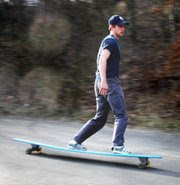
If that's a sentence you have never heard, you probably haven't heard of longboard skateboards. Longboards are the hottest thing in skateboarding for adults. At the basic level, longboards are exactly that: longer skateboards, from 42 to even 80 inches in length, compared with regular boards that are 30 to 38 inches. The biggest difference is these sidewalk surfboards are designed for comfortable riding, not X Games-type tricks on the halfpipe or at the skate park.

"A general rule of thumb is 'the longer the board, the older the rider,' " says Ken Perkins of Arbor Snowboards and Skateboards, whose Hawaii-influenced designs are among the most popular sold.

"It's not unusual to see 40-year-olds commuting on them. During the recent New York transit strike, I saw some Wall Street types riding their boards to work."

Longboards are more stable and smoother riding because the board is more flexible and the wheels are made of softer plastic, allowing them to roll over pebbles and rough concrete that could cause a trick boarder to crash.

"About 85% of skateboarders leave the sport by the time they reach 18," says Michael Brooke, publisher and editor of Concrete Wave, a magazine dedicated to longboarding. "The high attrition rate is due to the true difficulty of doing the tricks. They're very technical and sometimes dangerous."

In 1998, a U.S. Consumer Product Safety Commission study said 80% of the then-11.4 million U.S. skateboarders were under 18. Seven years later, a report by Transworld Skateboarding magazine said skaters 6 to 17 represented only half the nation's 16.4 million skateboarders. Hence the trend toward longboarding. It has become the No. 2-ranked skateboard activity in North America, according to a study by Label Networks, a Venice Beach, Calif., company that tracks youth culture trends. Street-style trick skating is first, and vert-park skating (half-pipe style tricks) is third.

"It is more utilitarian," Kathleen Gasperini, senior vice president of Label Networks, says of longboarding. "You can use it as transportation or have your dog pull you around the neighborhood.

"Girls (whose participation levels in longboarding are 2% higher than boys) love it because it is easier than dropping into a vert ramp and a lot more fun."

Transforming trends

As with regular skateboards, longboards have their gnarly roots in surfing. In the early 1600s, Hawaiian surfriders used 18- to 25-foot mahogany and balsa boards. The modern 8- to 12-foot surfboard emerged in the 1930s. Today's highly maneuverable plastic-foam boards are as small as 6 feet in length. Skateboarding went through a similar but more accelerated metamorphosis. Skateboarding was created in the late 1950s by bored surfers looking for something to do until wave conditions improved. They bolted skate wheels to planks and cruised beach roads and sidewalks, sometimes setting up slalom courses in parking lots. In the 1960s, however, Tony Alva and his merry band of Dogtown surfer-skaters developed a skateboarding style that mimicked the swooping cutback moves of real surfing. Boards got smaller to accommodate their use in empty swimming pools. This evolved into halfpipe ramps and street-skate parks that emphasized riding on rails and ledges.

"That's when they threw the baby out with the bathwater," Brooke says.

Long days journey

Today's longboards are a return to those early days of road riding and slalom racing. Some longboarders are even going to extremes, in a laid-back, longboard sort of way. Adam Colton and two of his friends rode their longboards nearly 3,000 miles from Newport, Ore., to his home in Springfield, Va., last year. They skated more than 50 miles a day and had to tape their sneakers with thick layers of duct tape to keep them from disintegrating.

"The key to the whole trip was switching legs to push off, otherwise I would have had one huge leg," Colton says.

Colton, 22, and associate Adam Stokowski, 21, also from Springfield, are taking longboards in a completely new direction by choreographing dance steps to be performed on them. They are also taping promotional videos for a line of longboards.

"I hurt my leg doing tricks," the lanky Stokowski says. "My parents are really happy that I'm able to make a living with longboards."

Parents aren't a visible component of trick skating, but Gasperini says longboards are giving the sport a cross-generational boost. "In longboarding, you now have parents who used to do vert riding skating with their young kids," she says. "This is the first time that has happened."


Original Source: USAToday

Wednesday, September 26, 2007

Skateboarding as transportation

Old School Bombers Longboards Cruisers
San Francisco, Ca. Everyday, unless it’s raining, Ramsey Garcia, 30, rolls his longboard (a three-foot skateboard with large black wheels) to San Francisco State or to work downtown. He rarely uses his a car and he doesn’t have a bicycle; the skateboard is his principle transportation from his house on Sloat Boulevard. “It takes a good portion out of my daily commute,” said Garcia, a native of San Clemente. “And it gets my heart rate up to keep me warm in a colder city.”


Longboard skateboards, different than those used for ollies, 360 flips and grinds, are becoming a trendy form of transportation. According to the San Francisco Skateboard Task Force, Garcia is one of an estimated 25,000 skateboarders who live in San Francisco. Many ride their boards as a form of alternative transportation although it’s illegal on city streets and many sidewalks. “Skateboard use, as transportation, on the streets and sidewalks of the city is rampant,” according to the Task Force’s 2004 Skateboard Master Plan. “While current law only permits skateboard use on residential sidewalks between dawn and dusk, real usage is going on nearly around the clock.”

For skaters like Garcia the ride can be a haphazard gauntlet of speeding cars, pedestrians, potholes and police. “Scary moments? I’ve had a few,” Garcia wrote in an e-mail, “a couple of close encounters with cars pulling out into traffic and not seeing me on the shoulder.” The law is another risk for skaters. When Garcia rolls to the east edge of the SFSU campus, he always tries to remember if it’s a protest day or not. If a protest is happening, he can’t ride through the sloped campus because University police are on the prowl, said Garcia. A run-in with the police could mean a ticket, a fine and possibly confiscation of his board. Garcia has been warned several times. “If I see them I try to hop off,” Garcia said. “Or I’ll have my headphones on and pretend like I don’t hear them.”


In California, skateboard law varies from county to county, city to city even sidewalk to sidewalk. State law allows “transit boards, public agencies, and local authorities,” to specify where skateboards can be used on public property. San Francisco traffic code states that skateboards cannot be used on any city street at any time, only on residential sidewalks from dawn to dusk. “When compared to other locales both in and out of California, San Francisco has the most restrictive code (as of January, 2004) to be found,” according to the Skateboard Master Plan.


The problem, said Adam Colton who in 2005 pushed his longboard 3,000 miles across the United States for charity, is that police don’t distinguish between street skaters that often damage property with their daring grinds and longboard skaters, which are usually harmlessly cruising. “Unfortunately, the law doesn’t allow for that,” said one San Francisco State University Police Officer. This results in skateboards being used for transportation throughout San Francisco “illegally as often as legally,” according to the Skateboard Task Force. But a few ‘no skateboarding’ signs and obscure traffic codes won’t stop skaters altogether. “Overall, this city has revived my passion for skating,” said Garcia, who has never been hassled by police for skateboarding outside of university grounds.

Original Source: Broowaha, By: DrSinValley

Saturday, September 8, 2007

Piper City "ramps up" unused tennis courts

skateboarding is not a crime
Piper City's little-used tennis court could be the site of "ramped-up" activity as the result of village board action on Wednesday.

In response to a request by about a dozen parents and children, the board agreed to dedicate one of the village's two tennis courts to skateboarding.

Parent Matt Johnson, 40, himself a one-time youthful skateboarder in Clifton and Bradley before settling in Piper City, served as spokesman for the group. The appeal followed recent confrontations between skateboarders and police acting to enforce a village ordinance against skateboarding on sidewalks. Business people, apparently fearing liability, had also asked that police chase skateboarders out of their parking lots.

The board said village insurance already covers persons injured on park playground equipment and noted the same coverage would extend to skateboarders.

"Jump boxes," which had been previously confiscated and stored in a village warehouse will be returned to the skateboarders for use in their new venue.


Original Source: Daily Journal, Il. by Mike Lyons

City of Vacaville lays the smack down on skaters

Skateboarding is not a crime


New restrictions could be in store for skateboarders in Vacaville after a city commission's ruling Tuesday night. By a 5-1 vote, the Community Services Commission backed a proposed ordinance, which would bar skateboards from some sections of sidewalk and other areas where they could compromise the safety of pedestrians. Commissioner Katherine Jordan cast the dissenting vote.

City code already prohibits bicycle riding in front of schools, stores or "buildings used for business purposes," according to a city staff report. The Vacaville Business Improvement District has asked for similar restrictions on skateboarding, the report explained, as businesses have reported safety hazards like near-miss collisions between walkers and skateboarders.

Also according to the report, there was a need to revise and update existing city code to "address contemporary skateboarding issues" and to include facilities that were not around or not problematic when the rules were adopted.

If the City Council adopts the ordinance, skateboarding would not be allowed at the city's three community centers, Town Square, the transit plaza, in park-and-ride lots, on sidewalks in business districts, and in parks unless on a path or a road. The city manager could also ban skateboards from sidewalks and walkways adjacent to businesses if he finds that is necessary to ensure public safety.

Arguing against the ordinance, resident Mike Lee said "I think it's not public safety, its a lack of tolerance that brought this on." Lee's son, 14-year-old Taylor, said sidewalks "are much better for beginners" than the city's skate park.

Frank Chavez, whose children are avid skateboarders, said, "I do understand the city's concern for the safety of the public." However, he and Lee questioned whether there were sufficient facilities in the city to accommodate its skateboarding population.

"Depending on the enforcement, I think you're going to have a lot of frustrated teenagers," Chavez said.

Commission Chair Pamela Greaves said if skateboarders are using the sidewalks to recreate, they need to find a more appropriate place. Like Goldberg, she emphasized that "the ordinance is not to ban skateboarding everywhere."

The proposal will be forwarded to the City Council with the commission's endorsement.

Original Source: The Vacaville Reporter, Jennifer Gentile