Showing posts with label parents. Show all posts

Friday, October 5, 2007

Skateboarding Family

Skateboarding can be a relatively inexpensive sport compared to golf or hockey, with an initial equipment outlay in the neighborhood of $150
Local skateboarder Jake Hibish shows off some of his award-winning moves on the ramp at his home. As the popularity of extreme sports continues to grow, one of our local lads is latching on to the phenomenon with full force. Jake Hilbish, of Forest, recently finished in second place in the Mid-Atlantic Skateboard Series (MASS).

Jake, the son of Brian and Debbie Hilbish, has been skating nearly all of his life. But that's not a surprise when you find out that his father has skateboarded nearly all of his life.

Brian Hilbish, a Brookville alum, was raised in Lynchburg where his skating antics, "got me run off quite a bit," in his words. After a stint in the Air Force, he earned his engineering degree at the University of Colorado. Through it all, Hilbish kept on skating.

Jake's older brother, Nathan, is working on an engineering degree at VCU. Debbie Hilbish said of him, "We tried the organized sports and they just didn't take. Nathan was timid until we put him on a board." She continued,"His confidence and grades all went up."

Jake started skating as a four year old. He played organized ball but felt compelled to make a choice and went with skateboarding.

This year, the family discovered the MASS, which consists of a series of events held in Northern Virginia and Maryland. The eight competitions ran from June until the end of August and are scored on a point system, similar to that used in NASCAR. Jake won three of the individual events outright.

One thing certainly working in his benefit is the existence of a skating ramp on the family's property. The ramp, designed and built by Brian Hilbish is 6 feet high, 24 feet wide and 40 feet long. "I built it because, at the time, that's all Nathan wanted to do," said Brian Hilbish.

It is actually the second ramp to grace the Hilbish estate, the first having been blown down by a tornado in 2001. In the immediate aftermath of that tornado, "Nathan was more worried about the ramp than anything else," Brian Hilbish noted with a chuckle.

Jake could find himself with some headier home-grown competition if some current plans come to fruition. There is a proposal to build a skate park at the Falling Creek Park here in Bedford.

If this park is built, Bedford would join the ranks of other communities that have built such attractions including Blacksburg, Roanoke, Vinton, Christiansburg and Salem.

Father and son skaters Brian (left) and Jake Hibish pose in front of the ramp that Brian built. As Brian Hilbish pointed out, "It's a sport in which some kids who aren't good at other sports kind find a niche. It's also a lifelong sport."

Jake enjoys the sport for a number of reasons. "It's really fun and exciting. You get an adrenaline rush from it," he noted. "You get to determine what things you want to do with a skateboard."

A demonstration by Jake on the skating ramp shows that it is a sport that takes a lot of stamina, strength and coordination. "A friend of mine lost a lot of weight just by skating," declared Jake.

Brian Hilbish added, "I think it's one of the greatest sports for kids if they're brought into the sport right and mentored properly." He also pointed out that skateboarding is a year-round sport that has a lot of camaraderie among the participants.

Skateboarding can be a relatively inexpensive sport compared to golf or hockey, with an initial equipment outlay in the neighborhood of $150.

And, it can be a sport for the more mature set, as well. "I started skating at the park because I was bored with just watching," said the older Hilbish. "For those over forty, if you start out slow and are padded, it's not really dangerous. In fact, a number of fathers have started getting into it."

Original Source: Bedford Bulletin, By Mike Forster

Parents Grappling With Skateboard Phenomenon

Your kids could be the next big thing in skateboarding
So, you took your son and daughter to the X Games and they got one look at Kerry Getz and Tony Hawk flying through the air and they decided right then and there they wanted to be a skateboarder. Along with the rest of the passing interests, the guitar that sits unplayed, the soccer cleats in the garage and the ice skating lessons that went nowhere, this must be the next phase, right? Maybe not.

"It's a lifestyle," said Steve Bradley, a skater and employee at Board Stiff in Media. "Everybody I know that skates, it's not all they think about, but it's always in their mind. The way they dress is from a skateboarding background. The way they act is from a skateboarding background. It's the basis of someone's lifestyle."

Bradley should know. The 22-year-old has been skating most of his life. Like the rest of the knowledgeable staff at the Media shop, he knows every nook and cranny of Delaware * County, skateboard-style. For around $130, a new skater can get set up with a board, trucks * and wheels *. Then it's all up to them. Bradley expects there will be another new generation of skateboarders after this summer. He has seen a sharp increase in sales since the X Games came through Philadelphia * last year and he is expecting the same sort of reaction again.

It's not just kids, Bradley said. The twenty- and thirtysomethings who stopped skating years before have been bitten by the bug again.

Like most longtime skaters, Bradley is skeptical of the X Games, Big Business, and the influence ESPN has over his beloved sport.

"As far as the X Games go, it's good for business," Bradley said. "It's good to get the kids out to see the pros. It helped make skateboarding huge. But personally, I won't go down to see it."

Bradley, like most skaters, is a street skater, a discipline that requires skaters to be creative when turning tricks. There are no set-up ramps, no half-pipes for street skaters. All you have are your board, yourself and whatever your environment provides, be it railings or benches or curbs.

"The best place to learn is skating with your friends in a cul-de-sac or in your neighborhood," Bradley said. "I don't recommend skate parks to kids who are just beginning because they are going to run into people who know what they're doing and they could get hurt."

There are no skate parks in Delaware County. The closest are in Avondale, Chester County, Willow Grove and in Ocean City, Md.

The most well-known natural skate park was in Philadelphia's FDR Plaza, better known as LOVE Park. Skaters from all over the world came to Philadelphia to test their skills at the park, and its popularity spread through video games and word of mouth. That is, skaters used to come to LOVE Park. That was before the city renovated the park and made it inhospitable to skaters who are now not welcome. Plans for a sanctioned skate park in Philadelphia near the Art Museum have been put on hold as city council members fight over the logistics. With no skate parks, and with Philadelphia out of the equation, kids in Delco do their riding in the street -- if they can find a street where skateboarding is allowed.

In Springfield, skateboarding is a crime in all public places. Media restricts skating in the downtown area. Bradley said the crackdowns have the opposite effect on young skaters.

"When skateboarding is banned, it's going to make kids want to do it more," Bradley said.

According to Bradley, the best places to skate are big open parking lots, especially at high schools. The best, Bradley said, was Strath Haven, but the school has since been placed off limits by police. With a sigh, Bradley repeats the often-heard lament of most skaters. "Skateboarding," he said, "gets a bad rap." It may look a little unorthodox. Its participants may not be cut from the "Leave it to Beaver" mold and the sport may scare a certain generation. But if you give it a try, it may lead to a whole new outlook on life. And that new skateboard could get considerably more use than that out-of-tune guitar.

Original Source: Delco Times, By Paul Flannery

Skater Punks, an essay by Kathy Fish

Skaters Need Skateboards. Don't just sit there, Get involved Today!
Skater Punks You know exactly what I am talking about. We have all seen them: the thrashed skate boards with nightmarish graphics, the bizarre array of boxers peeking out of the ridiculously baggy pants, jewelry protruding from places previously only inhabited by the stray hair trying to avoid being plucked, that's right, the skater punks. They aren't just boys or men; girls who played dress up and Barbie have thrown off the perception of pale pink and purple and are clad in black, brown, army green or any drab variation of the ominous colors Generation X has chosen for their coat of arms. Young men and women dress the same, walk the same, skate the same and sport the same flippantly arrogant attitude. What on earth would possess the youth of our nation to dress, behave and mutilate themselves in such a manner? Have you ever seen an X-Games skate board competition? These people are amazing. Why would you waste that athleticism and agility on a sport that has nothing to offer but a bad reputation, injury and trouble with the law?

"Mom, I'm home! Guess where Grandma took me to today. We found a skateboard at a garage sale and we bought it for $2.00 and we went to the skate park. It is so cool. I met some new friends and they showed me some tricks. Grandma is going to take me back next week," Conner, my then six year old, excitedly gushed as he walked through the front door.

Fear and anger seized me. I didn't know who to yell at first. Conner, seeing the fierce look in my eyes, yelled, "Grandma made me do it!" In her quest to become "cool," grandma had been turned to the "dark side." In Benedict Arnold style, facing battle and guaranteed desecration of her sainthood, she caved, switched allegiances, and sold me out for the price of a smile. I couldn't trust her, or the vipers she was now "hangin" with. Disbelief engulfed me like a dark, damp heavy cloud. My ally was gone, deserted; I stood alone to bear accusations like "you don't understand," "my friends who have cool parents get to skate," "you're closed minded and prejudiced," "just because you're old doesn't mean you know everything." The verbal battle was in full array and the arrows were hitting their target.

I pause from the narration at this time to relate an observation that has come as a morbid dose of reality for me. You will all have the following experience, at one time or another, it is unavoidable. You will supply grandchildren for your parents who have shamelessly begged, bribed, pleaded and blackmailed you to procreate. By giving in to their pleas you will have equipped them with the opportunity to earn their sainthood. Then, watching you stagger from a near fatal battle wound, they will step forward, take the sword from your child's hand and drive the final blow straight through your heart. With this one act they will forever endear themselves to your offspring and irrevocably reveal their true alliances— with them, against you.

'You know honey, you really should come check out the skate park before you make your final decision," a woman I did not know, who bore a striking resemblance to my mother, cooed logically. I spun around, a cornered, wild animal sensing the battle to ensue. "How dare you...We have talked endlessly about the problems with the youth of today, not the least of which is the 'skater-tude'... I entrusted my child to you and this is where you take him?...I don't care if he asked you to, be the adult,...show some back bone. You never had a problem saying the word 'no' when I was his age." My emotional diatribe was unashamedly being ignored. The traitor smiled, winked at Conner and said over her shoulder as she turned to leave: "Conner and I would be happy to let you tag along next time." I was speechless.

Defeated, weary from the staunch defense of ideals and perceptions my faculties began to call an all out retreat. "What could it hurt to go?...are you really afraid of some skater punks?...ratify your assumptions...prove your perceptions...isn't Conner worth your time...are you seriously going to let a 70-year-old grandma be more open-minded than you?" Finally with a sigh of surrender, "I'll go."

As I walked up the dirt trail to the "bowls" I tried to not look as scared as I felt. At first glance all I could see was concrete. There are two large "bowls" that are side by side and have a small lip that connects them. The "track" is the ring around the outer edge of the cement that incorporates two large ramps for building speed for jumps. In the middle there is a crisscross design with stairs and rails for "grinding." The design was ingenious, not much space but lots of options.

Conner threw his board down, put on his helmet, and off he rolled; around the track, up and down the ramps over and over, his smile spreading wider and wider across his innocent face. "Hi Conner," called a tall stereotypical skater. I bristled, started to step forward and the icy stiletto fingers from my childhood grabbed my arm. Without a word my mom rescued Conner from certain social death. "Hi Grandma, who's your friend?" the skater called out. Introductions were made and the grip on my perceptions began to erode.

Then my fears were realized, Conner took a nasty spill trying to grind. His board was too "sticky" to slide on the metal rail and he landed on his elbow and hip. To my surprise the skater punk got there before Conner's over protective mom. He gently picked him up, asked if he was okay, looked to make sure there was no blood, and walked him over to sit down.

"Next time borrow some of my wax to rub on the rail so it slides," came the helpful suggestion from the "punk." I was dumbfounded. Where were the "flippantly arrogant attitudes," disrespectful indifference, and the scorching defiant eyes? "He'll be okay, don't worry," the punk said reassuringly. "Thanks" I mumbled. "Mom, you said you rode a skateboard when you were young, try mine, its fun." "You rode a board? How cool, hop on and see if you remember how to roll" the skater kid smiled. "I wish my parents did something cool like that, then maybe they would understand. You are lucky Conner."

I didn't know whether to be embarrassed or proud. My tattle-tale conscience reminded me of those ten minutes earlier I was reciting the evils of skateboarding to myself. I cautiously placed Conner's board down and assumed the stance. The wheels rolled slowly at first, then faster and my confidence began to build. The adrenaline rush was instant. The faster I went the more intoxicated I felt. What a rush. I could do this all day.

"Mom, could I have my board now?""One more time around," I pleaded as I rolled quickly by."Come on mom, it's my board." I slowed down and jumped off. Conner took off and yelled "Hey mom, watch this."

Teachers come in all shapes, sizes and wear all kinds of different clothes. From eight to eighteen to seventy there are many different people from diverse walks of life that can show us things about who we are, who we think we are and most importantly who we want to become. I didn't change my choice of clothes, music or friends, but my custom board and pierced belly button have raised some eyebrows and given me the opportunity to do a little teaching of my own.

Original Source: realskate.com

Friday, September 28, 2007

Your Kid Doesn't Like Sports? They Can Still Stay Fit

Get those kids involved in outdoor activities, skateboarding is great for balance speed stamina and confidence Team sports can help a child gain self-esteem, coordination, and general fitness, and help them learn how to work with other kids and adults. But some kids aren't natural athletes and they may tell you - directly or indirectly - that they just don't like sports. What then?

Why Some Kids Don't Like Teams

Every child doesn't have to join a team, and with enough other activities, kids can be fit without them. But it's a good idea to find out why your child isn't interested. You might be able to help solve any deeper concerns your child might be having, or steer your child toward something else. Talk with your child and let him or her know that you'd like to work on a solution together. That solution might mean making changes and sticking with the team sport or finding a new activity to try.

Here are some reasons why sports might be a turnoff for a child:

Still Developing Basic Skills

Though many sports programs are available for preschoolers, it's not until about age 6 or 7 that most kids have the physical skills, the attention span, and the ability to grasp the rules needed to play organized sports. If your child hasn't had much practice in a specific sport, it may take a while for him or her to be expected to reliably perform necessary skills such as kicking a soccer ball on the run or hitting a baseball thrown from the pitcher's mound. Trying and failing, especially in a game situation, might frustrate your child and make him or her nervous.

What You Can Do. Practice with your child at home. Whether you're shooting baskets, playing catch, or going for a jog together, you're giving your child an opportunity to build his or her skills and fitness in a safe environment. Your child can freely try - and risk failing - new things without the self-consciousness of being around his or her peers. And you're also getting a good dose of quality together time.

Coach or League Is Too Competitive

A kid who's already a reluctant athlete might feel extra-nervous when the coach barks out orders or the league focuses heavily on winning.

What You Can Do. Investigate sports programs before signing your child up for one. Talk with coaches and other parents about the philosophy. Some athletic associations, like the YMCA, have noncompetitive leagues. In some programs, they don't even keep score.

Keep in mind that as kids get older, they can handle more competitive aspects such as keeping score and keeping track of wins and losses for the season. Some kids may be motivated by competitive play, but the average child may not be ready for the increased pressure until he or she is 11 or 12 years old. Remember that even in more competitive leagues, the atmosphere should remain positive and supportive for all the participants.

Stage Fright

If your child isn't a natural athlete, or is a little shy, he or she might be uncomfortable with the pressure of being on a team. More self-conscious kids also might worry about letting their parents, coaches, or teammates down. This is especially true if the child is still working on basic skills and if the league is very competitive.

What You Can Do. Keep your expectations realistic - most kids don't become Olympic medalists or get sports scholarships. Let your child know the goal is to be fit and have fun. If the coach or league doesn't agree, it's probably time to look for something new.

Still Shopping for a Sport

Some kids haven't found the right sport. Maybe your child didn't have the hand-eye coordination for baseball, but he or she has the drive and the build to be a swimmer, a runner, or a cyclist. The idea of an individual sport also can be more appealing to some kids who like to go it alone.

What You Can Do. Be open to your child's interests in other sports or activities. That can be tough if, for instance, you just loved basketball and wanted to continue the legacy. But by exploring other options, you give your child a chance to get invested in something he or she truly enjoys.

Other Barriers

Different kids mature at different rates, so it's common for there to be a wide range of heights, weights, and athletic abilities among kids of the same age group. So if your child is much bigger or smaller than other kids of the same age - or less coordinated or not as strong - he or she may feel self-conscious and uncomfortable competing with them. Your child also may be afraid of getting injured, or worried that he or she can't keep up. A child who is overweight might be reluctant to participate in a sport, for example, while a child who has asthma might feel more comfortable with sports that require short outputs of energy, like baseball, football, gymnastics, downhill skiing, and shorter track and field events.

What You Can Do. Give some honest thought to your child's strengths, abilities, and temperament, and find an activity that might be a good match. Some kids are afraid of the ball, so they don't like softball or volleyball, but may enjoy an activity like running. If your child is overweight, he or she might lack the endurance to run, but might enjoy a sport like swimming. Your child may be too short for the basketball team, but may enjoy gymnastics or wrestling.

Keep in mind that some kids just prefer sports that focus on individual performance rather than teamwork. Remember that the goal is to prevent your child from feeling frustrated, wanting to quit, and being turned off from sports and physical activity altogether.

With good communication, you may be able to address your child's concerns. Other issues may naturally fade as your child grows. If you can understand what your child is going through and provide a supportive environment, you can help your child succeed in whatever activity he or she chooses.

Ways to Stay Fit Outside of Team SportsEven kids who once said they hated sports might learn to like team sports as their skills improve, or if they find the right sport or a league with the right level of intensity. But even if team sports never thrill your child, there's plenty a kid can do to get the recommended 60 minutes or more of physical activity each day.

Free play can be very important for a child who doesn't play a team sport. What's free play? It's the activity kids get when they're left to their own devices, like shooting hoops, riding bikes, playing whiffleball, playing tag, jumping rope, or dancing.

Outside of the most common team sports, your child might want to try individual sports or other organized activities that can boost his or her fitness. Here are some ideas:

skateboarding
cycling
inline skating
martial arts
swimming
horseback riding
dance classes
cheerleading
hiking
golf
tennis
fencing
gymnastics
yoga and other fitness classes
Ultimate Frisbee
running

Supporting Your Kid's Choices

Even if the going's tough, work with your child to find something active that he or she likes. Try to remain open-minded. Maybe your child is interested in an activity that is not offered at his or her school. If your daughter wants to try flag football or ice hockey, for example, help her find a local league or talk to school officials about starting up a new team.

You'll need to be patient if your child has difficulty choosing and sticking to an activity. It often takes several tries before a child finds one that feels like the right fit. But when something clicks, you'll be glad you invested the time and effort. For your child, it's one big step toward developing active habits that can last a lifetime.

Original Source: kidshealth.org

Thursday, September 27, 2007

Longboarding, transportation trend among adults

No waves where you live? Start longboarding today!
"Hey, Dad, can I borrow your skateboard tonight?"

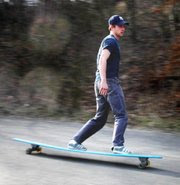
If that's a sentence you have never heard, you probably haven't heard of longboard skateboards. Longboards are the hottest thing in skateboarding for adults. At the basic level, longboards are exactly that: longer skateboards, from 42 to even 80 inches in length, compared with regular boards that are 30 to 38 inches. The biggest difference is these sidewalk surfboards are designed for comfortable riding, not X Games-type tricks on the halfpipe or at the skate park.

"A general rule of thumb is 'the longer the board, the older the rider,' " says Ken Perkins of Arbor Snowboards and Skateboards, whose Hawaii-influenced designs are among the most popular sold.

"It's not unusual to see 40-year-olds commuting on them. During the recent New York transit strike, I saw some Wall Street types riding their boards to work."

Longboards are more stable and smoother riding because the board is more flexible and the wheels are made of softer plastic, allowing them to roll over pebbles and rough concrete that could cause a trick boarder to crash.

"About 85% of skateboarders leave the sport by the time they reach 18," says Michael Brooke, publisher and editor of Concrete Wave, a magazine dedicated to longboarding. "The high attrition rate is due to the true difficulty of doing the tricks. They're very technical and sometimes dangerous."

In 1998, a U.S. Consumer Product Safety Commission study said 80% of the then-11.4 million U.S. skateboarders were under 18. Seven years later, a report by Transworld Skateboarding magazine said skaters 6 to 17 represented only half the nation's 16.4 million skateboarders. Hence the trend toward longboarding. It has become the No. 2-ranked skateboard activity in North America, according to a study by Label Networks, a Venice Beach, Calif., company that tracks youth culture trends. Street-style trick skating is first, and vert-park skating (half-pipe style tricks) is third.

"It is more utilitarian," Kathleen Gasperini, senior vice president of Label Networks, says of longboarding. "You can use it as transportation or have your dog pull you around the neighborhood.

"Girls (whose participation levels in longboarding are 2% higher than boys) love it because it is easier than dropping into a vert ramp and a lot more fun."

Transforming trends

As with regular skateboards, longboards have their gnarly roots in surfing. In the early 1600s, Hawaiian surfriders used 18- to 25-foot mahogany and balsa boards. The modern 8- to 12-foot surfboard emerged in the 1930s. Today's highly maneuverable plastic-foam boards are as small as 6 feet in length. Skateboarding went through a similar but more accelerated metamorphosis. Skateboarding was created in the late 1950s by bored surfers looking for something to do until wave conditions improved. They bolted skate wheels to planks and cruised beach roads and sidewalks, sometimes setting up slalom courses in parking lots. In the 1960s, however, Tony Alva and his merry band of Dogtown surfer-skaters developed a skateboarding style that mimicked the swooping cutback moves of real surfing. Boards got smaller to accommodate their use in empty swimming pools. This evolved into halfpipe ramps and street-skate parks that emphasized riding on rails and ledges.

"That's when they threw the baby out with the bathwater," Brooke says.

Long days journey

Today's longboards are a return to those early days of road riding and slalom racing. Some longboarders are even going to extremes, in a laid-back, longboard sort of way. Adam Colton and two of his friends rode their longboards nearly 3,000 miles from Newport, Ore., to his home in Springfield, Va., last year. They skated more than 50 miles a day and had to tape their sneakers with thick layers of duct tape to keep them from disintegrating.

"The key to the whole trip was switching legs to push off, otherwise I would have had one huge leg," Colton says.

Colton, 22, and associate Adam Stokowski, 21, also from Springfield, are taking longboards in a completely new direction by choreographing dance steps to be performed on them. They are also taping promotional videos for a line of longboards.

"I hurt my leg doing tricks," the lanky Stokowski says. "My parents are really happy that I'm able to make a living with longboards."

Parents aren't a visible component of trick skating, but Gasperini says longboards are giving the sport a cross-generational boost. "In longboarding, you now have parents who used to do vert riding skating with their young kids," she says. "This is the first time that has happened."


Original Source: USAToday

Wednesday, September 26, 2007

Keeping the Family Fit

Get those kids off the couch and outside skating
Getting fit is almost always at the top of adults’ to do list. But what about the kids? Too often couch-potato parents raise stroller-potato youngsters. With 10 percent of 2 to 5-year-olds and 16 percent of 6-to19-year-olds already overweight in the United States—and rising obesity rates in the rest of the world, experts say it’s crucial to get children moving early. Habits formed in childhood can often extend through adulthood. As New York pediatrician Jennifer Trachtenberg notes, “active kids do become active adults.” But that doesn't mean dragging your kids to the gym every day. “Any type of exercise is good, as long as it’s supervised, and parents are using common sense," says Keith Gorse, chair of the age-specific task force for the National Athletic Trainers’ Association.

Girls and boys just want to have fun. So let them. “Kids should play. They should move. They’re wired for these things naturally,” says pediatrician Peter Belamarich, associate professor of clinical pediatrics at the Albert Einstein College of Medicine in New York. Don’t forget to get down on the floor and play with your kids. Mike Monroe, a New York-certified strength and conditioning specialist who is lead trainer for an exercise program called PUSH, lets his 1-year-old son, Miles, crawl around him and on top of him. He also rolls a ball to Miles’s right side and then to his left. “People overanalyze what they think will help advance their kid,” says Monroe. Cedric Bryant, chief exercise physiologist for the American Council on Exercise, says he was like a “tree” for his four sons, now 10, 13, 15 and 17, when they were little, encouraging them to climb all over him. “One of the biggest mistakes parents make is to think it really has to be this really complex, packaged program and approach,” says Bryant. “The key is just to get your children to move. Just make sure it’s fun.” Don’t rush into organized sports. The American Academy of Pediatrics recommends only 15 minutes of “structured activity” for preschoolers. After all, little kids’ attention spans are short, and they should be playing and exploring rather than doing formal calisthenics. The AAP statement also notes that participating in sports that aren’t age appropriate can cause problems: “When the demands of a sport exceed a child’s cognitive and physical development, the child may develop feelings of failure and frustration.” Enrolling them in ballet or gymnastics for tots is fine, with a caveat. “The key is not to take it too seriously,” says Dr. Angela Smith, an orthopedic surgeon at the Children’s Hospital of Philadelphia who is past president of the American College of Sports Medicine. Whether your child grows into a basketball superstar comes down to nature and nurture, says Small. “There’s genes and what you do with those genes.”

Turn off the television. The American Academy of Pediatrics recommends no TV for kids under 2, and no more than two hours of total screen time (TV, videogames, computers) for older children. Belamarich, a New York pediatrician, finds it sad when he asks kids to tell him about their hobbies and they say Playstation and XBox. “I’m seeing a bunch of kids pushing buttons hour after hour,” he says. Kids who watch more than 10 hours of TV each week are more likely to be overweight, aggressive and slow to learn in school, according to the American Medical Association. There are also concerns that kids who are “over stimulated” by TV and videos may be more prone to Attention Deficit Disorder. If your kids can’t resist the lure of the computer, have them engage in a “learning activity instead of a mindless activity,” says Vehrs of BYU.

Be a good role model. “Set the example of knowing that activity is as important as brushing your teeth,” says Sandra Perlmutter, former executive director of the President’s Council on Physical Fitness and Sports and an adviser to a company called athleticBaby. It’s good for kids to see you head out on a run. (But don’t take them with you in a Baby Jogger until they’re at least six months old because they lack sufficient control of their heads.) Walk with your little ones. Or get them to “exercise” with you. Every day, Baton Rouge, La., speech pathologist April Garrity, 29, and her daughter, Susanna, do “downward facing dog” and other yoga moves together. Susanna also likes doing push-ups along with her dad. “They see us working out,” says Garrity. And they naturally want to join in the fun.

Tuesday, September 25, 2007

Parents should let kids be kids

The RAMP Skateboard Shop has skateboards, parts, and gear for all ages and sizes. Skateboarding is fun for the whole family!
Shaun White loved soccer, but there was a moment when he learned it wasn't for him."I showed up at the field late one time, and it was intense," he said. "I'm playing on this lower, recreation level, just so I could have fun. Someone else's mom came over and yelled at me, 'You better get out there and you better score!' There is something about someone else's mom yelling at you."

White said he did as he was told and shortly thereafter he quit. Instead of traditional organized sports, he gravitated to nontraditional activities like snowboarding and skateboarding. The 21-year-old, who won an Olympic gold medal in snowboarding in 2006 and an X Games gold medal this summer in skateboarding, said the decision changed his life and his relationship with his parents.

"Instead of my dad yelling at me from the sideline, we were out riding together," he said. "(Snowboarding) really drew our family together."

The professional skateboarder who was in Salt Lake City this week to compete in the AST Dew Tour said he believes a lot of young athletes turn to nontraditional sports because they have more freedom.

"Normally, there are no moms allowed in the parks," he laughed. "It's brutal when you have people always telling you what to do. My attraction to skateboarding was that you didn't have that. You could just ask your friends, learn tricks from each other or just figure it out on your own."

Original Source: Deseret Morning News, Amy Donaldson