
"Hey, Dad, can I borrow your skateboard tonight?"
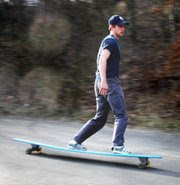
If that's a sentence you have never heard, you probably haven't heard of longboard skateboards. Longboards are the hottest thing in skateboarding for adults. At the basic level, longboards are exactly that: longer skateboards, from 42 to even 80 inches in length, compared with regular boards that are 30 to 38 inches. The biggest difference is these sidewalk surfboards are designed for comfortable riding, not X Games-type tricks on the halfpipe or at the skate park.
"A general rule of thumb is 'the longer the board, the older the rider,' " says Ken Perkins of Arbor Snowboards and Skateboards, whose Hawaii-influenced designs are among the most popular sold.
"It's not unusual to see 40-year-olds commuting on them. During the recent New York transit strike, I saw some Wall Street types riding their boards to work."
Longboards are more stable and smoother riding because the board is more flexible and the wheels are made of softer plastic, allowing them to roll over pebbles and rough concrete that could cause a trick boarder to crash.
"About 85% of skateboarders leave the sport by the time they reach 18," says Michael Brooke, publisher and editor of Concrete Wave, a magazine dedicated to longboarding. "The high attrition rate is due to the true difficulty of doing the tricks. They're very technical and sometimes dangerous."
In 1998, a U.S. Consumer Product Safety Commission study said 80% of the then-11.4 million U.S. skateboarders were under 18. Seven years later, a report by Transworld Skateboarding magazine said skaters 6 to 17 represented only half the nation's 16.4 million skateboarders. Hence the trend toward longboarding. It has become the No. 2-ranked skateboard activity in North America, according to a study by Label Networks, a Venice Beach, Calif., company that tracks youth culture trends. Street-style trick skating is first, and vert-park skating (half-pipe style tricks) is third.
"It is more utilitarian," Kathleen Gasperini, senior vice president of Label Networks, says of longboarding. "You can use it as transportation or have your dog pull you around the neighborhood.
"Girls (whose participation levels in longboarding are 2% higher than boys) love it because it is easier than dropping into a vert ramp and a lot more fun."
Transforming trends
As with regular skateboards, longboards have their gnarly roots in surfing. In the early 1600s, Hawaiian surfriders used 18- to 25-foot mahogany and balsa boards. The modern 8- to 12-foot surfboard emerged in the 1930s. Today's highly maneuverable plastic-foam boards are as small as 6 feet in length. Skateboarding went through a similar but more accelerated metamorphosis. Skateboarding was created in the late 1950s by bored surfers looking for something to do until wave conditions improved. They bolted skate wheels to planks and cruised beach roads and sidewalks, sometimes setting up slalom courses in parking lots. In the 1960s, however, Tony Alva and his merry band of Dogtown surfer-skaters developed a skateboarding style that mimicked the swooping cutback moves of real surfing. Boards got smaller to accommodate their use in empty swimming pools. This evolved into halfpipe ramps and street-skate parks that emphasized riding on rails and ledges.
"That's when they threw the baby out with the bathwater," Brooke says.
Long days journey
Today's longboards are a return to those early days of road riding and slalom racing. Some longboarders are even going to extremes, in a laid-back, longboard sort of way. Adam Colton and two of his friends rode their longboards nearly 3,000 miles from Newport, Ore., to his home in Springfield, Va., last year. They skated more than 50 miles a day and had to tape their sneakers with thick layers of duct tape to keep them from disintegrating.
"The key to the whole trip was switching legs to push off, otherwise I would have had one huge leg," Colton says.
Colton, 22, and associate Adam Stokowski, 21, also from Springfield, are taking longboards in a completely new direction by choreographing dance steps to be performed on them. They are also taping promotional videos for a line of longboards.
"I hurt my leg doing tricks," the lanky Stokowski says. "My parents are really happy that I'm able to make a living with longboards."
Parents aren't a visible component of trick skating, but Gasperini says longboards are giving the sport a cross-generational boost. "In longboarding, you now have parents who used to do vert riding skating with their young kids," she says. "This is the first time that has happened."
If that's a sentence you have never heard, you probably haven't heard of longboard skateboards. Longboards are the hottest thing in skateboarding for adults. At the basic level, longboards are exactly that: longer skateboards, from 42 to even 80 inches in length, compared with regular boards that are 30 to 38 inches. The biggest difference is these sidewalk surfboards are designed for comfortable riding, not X Games-type tricks on the halfpipe or at the skate park.
"A general rule of thumb is 'the longer the board, the older the rider,' " says Ken Perkins of Arbor Snowboards and Skateboards, whose Hawaii-influenced designs are among the most popular sold.
"It's not unusual to see 40-year-olds commuting on them. During the recent New York transit strike, I saw some Wall Street types riding their boards to work."
Longboards are more stable and smoother riding because the board is more flexible and the wheels are made of softer plastic, allowing them to roll over pebbles and rough concrete that could cause a trick boarder to crash.
"About 85% of skateboarders leave the sport by the time they reach 18," says Michael Brooke, publisher and editor of Concrete Wave, a magazine dedicated to longboarding. "The high attrition rate is due to the true difficulty of doing the tricks. They're very technical and sometimes dangerous."
In 1998, a U.S. Consumer Product Safety Commission study said 80% of the then-11.4 million U.S. skateboarders were under 18. Seven years later, a report by Transworld Skateboarding magazine said skaters 6 to 17 represented only half the nation's 16.4 million skateboarders. Hence the trend toward longboarding. It has become the No. 2-ranked skateboard activity in North America, according to a study by Label Networks, a Venice Beach, Calif., company that tracks youth culture trends. Street-style trick skating is first, and vert-park skating (half-pipe style tricks) is third.
"It is more utilitarian," Kathleen Gasperini, senior vice president of Label Networks, says of longboarding. "You can use it as transportation or have your dog pull you around the neighborhood.
"Girls (whose participation levels in longboarding are 2% higher than boys) love it because it is easier than dropping into a vert ramp and a lot more fun."
Transforming trends
As with regular skateboards, longboards have their gnarly roots in surfing. In the early 1600s, Hawaiian surfriders used 18- to 25-foot mahogany and balsa boards. The modern 8- to 12-foot surfboard emerged in the 1930s. Today's highly maneuverable plastic-foam boards are as small as 6 feet in length. Skateboarding went through a similar but more accelerated metamorphosis. Skateboarding was created in the late 1950s by bored surfers looking for something to do until wave conditions improved. They bolted skate wheels to planks and cruised beach roads and sidewalks, sometimes setting up slalom courses in parking lots. In the 1960s, however, Tony Alva and his merry band of Dogtown surfer-skaters developed a skateboarding style that mimicked the swooping cutback moves of real surfing. Boards got smaller to accommodate their use in empty swimming pools. This evolved into halfpipe ramps and street-skate parks that emphasized riding on rails and ledges.
"That's when they threw the baby out with the bathwater," Brooke says.
Long days journey
Today's longboards are a return to those early days of road riding and slalom racing. Some longboarders are even going to extremes, in a laid-back, longboard sort of way. Adam Colton and two of his friends rode their longboards nearly 3,000 miles from Newport, Ore., to his home in Springfield, Va., last year. They skated more than 50 miles a day and had to tape their sneakers with thick layers of duct tape to keep them from disintegrating.
"The key to the whole trip was switching legs to push off, otherwise I would have had one huge leg," Colton says.
Colton, 22, and associate Adam Stokowski, 21, also from Springfield, are taking longboards in a completely new direction by choreographing dance steps to be performed on them. They are also taping promotional videos for a line of longboards.
"I hurt my leg doing tricks," the lanky Stokowski says. "My parents are really happy that I'm able to make a living with longboards."
Parents aren't a visible component of trick skating, but Gasperini says longboards are giving the sport a cross-generational boost. "In longboarding, you now have parents who used to do vert riding skating with their young kids," she says. "This is the first time that has happened."
Original Source: USAToday


